
A Local’s Guide to Scenic Walks, Historic Sites, Wildlife Viewing, Mountain Drives, and Free Things to do in Gatlinburg
Why Some of the Best Gatlinburg Experiences Are Completely Free

One of the biggest surprises for first-time visitors to Gatlinburg is discovering that some of the area’s most unforgettable experiences aren’t found behind a ticket booth, inside an attraction, or at the end of a long line on the Parkway.
I’ve lost count of the number of travelers I’ve met who arrived with a carefully planned itinerary packed with rides, shows, museums, and attractions, only to tell me later that their favorite memory of the entire trip was something much simpler. Sometimes it was watching the morning fog drift across the ridges from a mountain overlook. Sometimes it was spotting a deer quietly feeding beside a creek. Other times it was simply sitting along the Little Pigeon River, coffee in hand, listening to the water rush past while downtown Gatlinburg slowly came to life.
That’s one of the reasons I enjoy this corner of the Smokies so much. While Gatlinburg offers plenty of attractions worth experiencing, the true character of the region often reveals itself in places that don’t charge admission.
A drive along Newfound Gap Road can deliver mountain views that stretch for miles across Tennessee and North Carolina. A short walk to Cataract Falls feels worlds away from the crowds on the Parkway despite being only minutes from downtown. The historic cabins and homesteads scattered throughout the Roaring Fork area tell the story of Appalachian families who built lives here long before tourism became the area’s primary industry. Even an afternoon wandering through The Village Shops can become memorable when you slow down enough to notice the details—the sound of rushing water beneath a footbridge, the scent of fresh taffy being pulled at Ole Smoky Candy Kitchen, or the mountains rising beyond the rooftops in the distance.
The Great Smoky Mountains have always rewarded curiosity more than spending. Visitors willing to step away from the busiest ticket lines often discover scenic trails, quiet rivers, hidden overlooks, wildlife viewing opportunities, and fascinating pieces of local history that cost absolutely nothing to experience.
In this guide, you’ll discover 25 genuinely free attractions, scenic drives, historic sites, wildlife viewing areas, and hidden local experiences that can easily fill an entire day—or even an entire vacation—without requiring an admission ticket.
Before we go any further, it’s worth clearing up one important point that often confuses visitors. Great Smoky Mountains National Park remains one of the few national parks in America with no entrance fee. However, parking inside park boundaries for more than 15 minutes requires a daily, weekly, or annual parking tag. Throughout this guide, I’ll point out which attractions fall inside the park and which downtown experiences can be enjoyed without needing a parking tag at all.
As someone who regularly explores these roads, trails, overlooks, and backroads throughout the year, I’ve found that many visitors unknowingly drive past some of the area’s best free experiences while heading toward the more heavily advertised attractions.
That distinction matters because it is entirely possible to enjoy a full day of free activities in Gatlinburg without spending money on admission tickets. In fact, many visitors are surprised to learn that the Gatlinburg Trolley system is completely free to ride, making it easy to explore much of town without constantly moving your vehicle. You’ll also find unexpected cultural gems such as the Arrowmont School of Arts and Crafts galleries, where visitors can enjoy exhibits celebrating Appalachian creativity without paying an admission fee.
Of course, most travelers eventually mix these free experiences with some of the area’s classic attractions. If you’re still building your itinerary, our guide to the best things to do in Gatlinburg can help you combine free activities with the region’s most popular experiences. Likewise, choosing accommodations near downtown or near the national park entrances can make exploring much easier, and our guide to the best places to stay in Gatlinburg can help you find the right basecamp for your trip. After a day spent exploring trails, scenic drives, rivers, and historic sites, you’ll probably be ready for a good meal as well, which is why we’ve also created a complete guide to the top restaurants in Gatlinburg.
The purpose of this guide, however, is to focus on experiences that are genuinely free. No hidden admission fees. No attractions that require a purchase once you arrive. No gimmicks disguised as free activities. Just real places, authentic experiences, and some of the most rewarding corners of Gatlinburg and the Smokies that can be enjoyed for little more than your time and curiosity.
For travelers who value authentic experiences over expensive distractions, those often become the moments they remember long after the vacation is over. Years from now, you may not remember how much a ticket cost or how long you stood in line. But you’ll likely remember the mountain views from Newfound Gap, the peaceful sound of a rushing creek beside a forest trail, or the quiet satisfaction of discovering that some of Gatlinburg’s best experiences were completely free all along.
The Insider’s Rulebook for Free Activities in Gatlinburg
One of the easiest ways to stretch your vacation budget in Gatlinburg is also one of the most overlooked: understanding how the town and the national park work before you arrive.
I’ve met plenty of visitors who spent more on parking than they expected, drove past incredible free attractions without realizing they were there, or assumed every worthwhile experience in the Smokies came with an admission fee attached. The truth is quite the opposite. Some of the most rewarding experiences in the region cost absolutely nothing, but a little local knowledge can make the difference between a truly budget-friendly day and one filled with unexpected expenses.
Before we start exploring trails, scenic drives, historic sites, and hidden corners of the Smokies, it’s worth understanding a few simple rules that can save both money and frustration during your trip.
Understanding the Great Smoky Mountains Parking Tag
One of the most common misconceptions among first-time visitors is that Great Smoky Mountains National Park charges an entrance fee.
It doesn’t.
In fact, the Smokies remain one of the few national parks in America where admission is completely free. You can drive Newfound Gap Road, enjoy mountain overlooks, cross the Tennessee-North Carolina state line, and explore many of the park’s most famous locations without ever paying a gate fee.
However, there is one important detail that catches many visitors by surprise.
If your vehicle is parked anywhere inside the national park for more than 15 minutes, you’ll need a valid parking tag displayed in your vehicle. The current options are straightforward:
- Daily Parking Tag: $5
- Weekly Parking Tag: $15
- Annual Parking Tag: $40
For most Gatlinburg visitors spending several days exploring the park, the weekly tag is usually the best value.
It’s also important to know that parking tags must be physically displayed in your vehicle. Rangers cannot verify a pass sitting on your phone screen after you’ve left the car. If you purchase a tag online, you’ll need to print it before arriving, or you can purchase one from authorized locations near the park.
This rule applies to many of the free attractions featured throughout this guide, including the Gatlinburg Trail, Cataract Falls, Sugarlands Valley Nature Trail, portions of Roaring Fork Motor Nature Trail, and many of the scenic pull-offs along Newfound Gap Road.
As someone who spends a great deal of time exploring the Smokies throughout the year, I’ve found that most visitors don’t mind the parking tag once they understand what it supports. The revenue helps maintain the roads, trails, visitor centers, and historic structures that make this national park such a remarkable place to explore.
The key is simply knowing about it before you arrive.
Free Things to Do in Downtown Gatlinburg (No Park Tag Required)
The good news is that some of Gatlinburg’s best free experiences don’t require entering the national park at all.
In fact, you can spend an entire day exploring downtown Gatlinburg without needing a park parking tag.
One of my favorite places to slow down is The Village Shops. Hidden just off the Parkway, this collection of brick walkways, fountains, and European-inspired architecture feels surprisingly peaceful considering its location in the middle of town. Even visitors who never buy a thing often find themselves lingering here longer than expected. It is simply one of the most pleasant places to wander in Gatlinburg.
Another often-overlooked advantage for budget-conscious travelers is the Gatlinburg Trolley system. The trolleys are completely free to ride and connect many of the town’s most popular areas.
There is, however, one important local tip many travel guides fail to mention.
While the trolley itself is free, many downtown parking lots are not. If you’re driving into town specifically to use the trolley, consider parking at the Gatlinburg Welcome Center on Highway 441 near the Spur. Parking there is free, and it serves as one of the easiest places to hop aboard the trolley system without adding parking fees to your day.
A short distance away, the Arrowmont School of Arts and Crafts offers another experience that many visitors accidentally miss. Its galleries showcase Appalachian craftsmanship, regional artists, and creative traditions that have helped shape the Smokies for generations. Walking through the exhibits feels less like visiting a tourist attraction and more like discovering an important piece of the community’s cultural identity.
When the Parkway starts feeling crowded, I often find myself drifting toward River Road. The quieter sidewalks and sections of the River Road Walkway follow the West Prong of the Little Pigeon River, offering shaded benches, rushing water, and a completely different atmosphere from the busy main strip. It’s one of those places that reminds you that Gatlinburg is still a mountain town at heart, even during its busiest tourist seasons.
These aren’t necessarily the attractions you’ll see on the front cover of every vacation brochure, but they’re often the places visitors remember most.
How to Build an Entire Free Day in Gatlinburg
One of the biggest myths about Gatlinburg is that you need a large entertainment budget to enjoy a full day here.
You really don’t.
In fact, some of my favorite days in the Smokies have cost little more than a cup of coffee and a willingness to slow down.
A perfect free day often begins early, before the crowds have fully arrived. Start your morning near the Gatlinburg Trail and take advantage of the cooler temperatures and softer mountain light. Walk along the river, visit Cataract Falls, and spend a little time around the Sugarlands area before most visitors have finished breakfast. Early mornings in the Smokies possess a quiet beauty that disappears later in the day.
By late morning, continue exploring the park’s scenic roads. A leisurely drive along Newfound Gap Road allows you to stop at overlooks, enjoy the changing mountain views, and appreciate why this route is considered one of the most scenic drives in the eastern United States. If you’re visiting during spring, summer, or fall, don’t be surprised if wildlife sightings become part of the experience.
As the afternoon arrives, shift your focus toward downtown Gatlinburg. Park once and explore on foot. Wander through The Village Shops, visit the galleries at Arrowmont, watch the taffy being pulled at Ole Smoky Candy Kitchen, and spend some time beside the river. If you want to cover more ground without moving your vehicle, hop aboard the free Gatlinburg Trolley and enjoy seeing different parts of town.
One local strategy I often recommend is to avoid treating Gatlinburg like a checklist. Instead of rushing from one attraction to another, allow time for the unexpected. Sit beside the river for a while. Stop at an overlook that wasn’t on your itinerary. Wander down a side street simply because it looks interesting. Those unplanned moments often become the highlights of a trip.
As evening approaches, return to the mountains. Roaring Fork Motor Nature Trail is especially beautiful during the golden hour, when sunlight filters through the trees and the historic cabins seem to glow against the forest backdrop. If Roaring Fork is closed seasonally, Newfound Gap Road offers several outstanding overlooks where you can watch the mountains gradually shift from green to blue to smoky gray as the sun drops below the ridges.
It’s a fitting way to end a day that costs almost nothing.
If there’s one lesson I’ve learned after countless visits to Gatlinburg, it’s that the Smokies reward a slower pace. The people who rush from attraction to attraction often miss the very things they traveled here to experience. Meanwhile, the travelers who pause beside a creek, linger at an overlook, or take the scenic route home usually leave with the best stories.
And more often than not, those stories are completely free.
One of the easiest ways to stretch your vacation budget even further is choosing lodging close to the places you’ll actually spend time exploring. Staying near downtown or the national park entrances can save both time and hassles.
Free Scenic Walks and Nature Experiences
One of the greatest gifts Gatlinburg offers visitors is how quickly it reconnects you with nature. Unlike many mountain destinations where reaching the wilderness requires a long drive or a strenuous hike, some of the Smokies’ most rewarding experiences begin just minutes from downtown.
I’ve always appreciated how accessible these walks are. You don’t need expensive hiking equipment, years of outdoor experience, or exceptional fitness. Whether you’re traveling with young children, bringing grandparents along for the trip, pushing a stroller, walking your dog, or simply looking for a peaceful place to stretch your legs, these easy nature experiences provide an authentic introduction to the Great Smoky Mountains.
The best part? Every one of these locations allows you to experience the forests, rivers, wildlife, and history that made the Smokies America’s most visited national park—without spending a dime on admission.
Gatlinburg Trail: The Dog-Friendly Gateway Between Town and the Smokies
Why This Trail Is So Unique
The Gatlinburg Trail is unlike almost every other trail in Great Smoky Mountains National Park.
While most park trails begin deep inside the mountains, this one begins right on the edge of town and follows the West Prong of the Little Pigeon River toward Sugarlands Visitor Center. The result is a scenic walk that literally connects downtown Gatlinburg with the national park.
The trail stretches approximately 1.9 miles one way, making it roughly a 3.8-mile round-trip walk if you complete the entire route.
The Secret Most Visitors Don’t Know
For travelers visiting Gatlinburg with a dog, this trail is especially valuable.
The Gatlinburg Trail is one of only two trails in the entire 522,000-acre national park where leashed dogs are permitted. It is also one of only two trails where bicycles are allowed.
Because pets are restricted on nearly every other trail in the park, this becomes one of the best free activities in Gatlinburg for travelers who don’t want to leave their four-legged companion behind.
Highlights Along the Trail
The river is the star attraction here.
Much of the walk follows the Little Pigeon River, offering constant views of rushing water, mountain vegetation, and occasional wildlife. The trail crosses a beautiful pedestrian footbridge and passes several historic remnants, including old chimneys, stone foundations, and traces of long-abandoned mountain homesteads.
These quiet reminders of the area’s past are easy to miss if you’re rushing, but they add an entirely different dimension to the walk.
Practical Tips Before You Go
The trail surface is mostly gravel and packed dirt, making it suitable for most visitors.
One particularly useful budget-travel advantage is that visitors staying downtown can often walk directly to the trail without needing to move their vehicle at all. That means you can enjoy a national park experience without worrying about additional parking logistics.
My Personal Take
If I only had one hour to introduce a first-time visitor to the Smokies, this is probably where I’d take them.
The Gatlinburg Trail perfectly captures what makes this region special. Within a few minutes, the sounds of the Parkway disappear, replaced by flowing water, birdsong, and the feeling that you’ve stepped into a completely different world.
It’s the easiest transition from tourism to wilderness you’ll find anywhere in Gatlinburg.
Cataract Falls and Fighting Creek Nature Trail
One Walk, Two Experiences
Many travel guides treat Cataract Falls and Fighting Creek Nature Trail as separate attractions, but they’re really part of the same experience.
Both begin behind Sugarlands Visitor Center, making it easy to combine them into one enjoyable outing.
If you only want to see the waterfall, you’ll find one of the easiest walks in the Smokies. If you’re willing to continue beyond the falls, you’ll discover one of the quieter forest loops near Gatlinburg.
The Walk to Cataract Falls
The short walk to Cataract Falls is one of the most family-friendly nature experiences in the entire region.
A gentle path leads through a shaded forest before arriving at a charming 25-foot waterfall cascading over moss-covered rocks. It isn’t the largest waterfall in the Smokies, but that’s not really the point.
The setting feels intimate and peaceful, especially during the morning hours before crowds arrive.
For families with small children, older travelers, or anyone seeking a quick nature stop, Cataract Falls is difficult to beat.
Continuing Along Fighting Creek Nature Trail
Most visitors turn around at the waterfall.
That’s a mistake.
Continuing onto the Fighting Creek Nature Trail rewards visitors with a quieter forest experience, fewer crowds, and a deeper sense of what the Smokies looked like before tourism arrived.
Towering hardwood trees, seasonal wildflowers, and occasional wildlife sightings create an atmosphere that feels remarkably removed from the nearby visitor center.
The Historic Reward: John Ownby Cabin
The true hidden gem along this loop is the John Ownby Cabin.
Built in 1860 from hand-hewn logs, the cabin stands as one of the last surviving homes from the historic Forks-of-the-River community that once occupied this valley.
Standing beside the structure, it’s easy to imagine what life was like here before roads, visitor centers, and millions of annual visitors transformed the region.
For history lovers, this stop alone makes the walk worthwhile.
Things To Know Before You Go
The complete loop, including the waterfall spur, remains relatively easy for most visitors.
Unlike the Gatlinburg Trail, pets and bicycles are not permitted here.
Because the trail begins near Sugarlands Visitor Center, parking tags are required if you’re parked longer than 15 minutes.
My Personal Take
This area perfectly represents what I love about the Smokies.
You can experience a beautiful waterfall, walk through mature forest, encounter Appalachian history, and potentially spot wildlife—all within a relatively short distance from your vehicle.
That’s a remarkable amount of value for a completely free experience.
Sugarlands Valley Nature Trail: The Most Accessible Nature Experience in the Smokies
Why This Trail Matters
One of the strengths of Great Smoky Mountains National Park is that it can be enjoyed by almost everyone.
The Sugarlands Valley Nature Trail demonstrates that better than perhaps any other trail near Gatlinburg.
Located near Sugarlands Visitor Center, this half-mile paved loop was specifically designed to provide a fully accessible outdoor experience.
Highlights of the Trail
The path winds through beautiful forest scenery while remaining relatively flat and easy to navigate.
Wheelchair users, visitors using walkers, parents pushing strollers, and travelers seeking a gentle walk can all experience the sights and sounds of the Smokies without dealing with steep terrain or uneven footing.
Wooden bridges cross small waterways, benches provide opportunities to rest, and interpretive features help visitors appreciate the surrounding landscape.
The Hidden Detail Most Visitors Miss
Here’s one of my favorite local details.
Look closely at portions of the concrete trail surface.
During construction, a black bear reportedly wandered across freshly poured concrete, leaving behind paw prints that remain visible today.
Children especially enjoy searching for them, and it adds a fun element to an otherwise peaceful walk.
Things To Know Before You Go
The paved loop measures approximately half a mile and is one of the most accessible outdoor experiences anywhere near Gatlinburg.
Like neighboring attractions, parking regulations apply if you’re using the Sugarlands parking area.
My Personal Take
Some travelers assume accessible trails are somehow less rewarding.
This trail proves otherwise.
The forest doesn’t care how fast you walk, how old you are, or what mobility aids you use. It simply invites you to experience the Smokies, and this trail makes that invitation available to everyone.
Little River Road Scenic Pull-Offs
The Most Underrated Free Attraction in Gatlinburg
Many visitors drive Little River Road simply to reach another destination.
In my opinion, that’s one of the biggest mistakes people make in the Smokies.
The road itself is an attraction.
Following the course of the Little River, this scenic corridor provides some of the best free views in the entire national park.
Must-See Stops Along the Way
One of the most famous stops is The Sinks.
This dramatic section of river funnels an enormous volume of water through a narrow rock channel, creating powerful rapids that can be enjoyed from just steps away from your vehicle.
Another worthwhile stop is Maloney Point, where elevated views reveal layers of mountain ridges stretching into the distance.
Throughout the drive, numerous unnamed pull-offs provide equally rewarding opportunities for photography, wildlife viewing, and quiet reflection.
Perfect for Photographers and Picnic Lovers
The changing light throughout the day makes Little River Road especially appealing for photographers.
Spring wildflowers, summer greenery, autumn foliage, and winter mountain vistas each create a completely different experience.
Many pull-offs also offer easy access to picnic areas, riverside boulders, and peaceful spots to enjoy lunch beside the water.
Things To Know Before You Go
If you’re simply stopping briefly for photographs, parking tag requirements generally don’t apply when remaining under the park’s 15-minute threshold.
However, if you plan to spend time exploring, picnicking, or relaxing beside the river, make sure you display the appropriate parking tag.
My Personal Take
If I could offer one piece of Smoky Mountain advice, it would be this:
Don’t rush Little River Road.
Pull over. Walk to the river. Listen to the water. Stay a little longer than planned.
The Smokies aren’t a place that rewards speed. They’re a place that rewards attention.
And few roads illustrate that lesson better than this one.
Free Scenic Drives Around Gatlinburg
One of the greatest joys of visiting the Great Smoky Mountains is realizing that some of the most jaw-dropping panoramas in North America can be experienced right from your driver’s seat.
While the hiking trails get plenty of press, hitting the winding asphalt allows you to cover vast geographic terrain, experience dramatic elevation changes across distinct ecological climates, and enjoy sweeping vistas without taking a single step. These five routes around Gatlinburg are destinations in their own right. Pack a thermos of coffee, drop your window down to catch the mountain air, and utilize the free pull-offs to let the scenery unfold.
1. Newfound Gap Road (The Essential Trans-Mountain Highway)
Newfound Gap Road (U.S. Highway 441) is the undisputed crown jewel of mountain drives in East Tennessee. Cutting directly through the center of the national park, this 33-mile scenic highway climbs nearly 3,000 vertical feet from downtown Gatlinburg up and over the mountain crest into North Carolina.
- The Route Layout: You begin driving through low-elevation hardwood forests near the Sugarlands area. As your vehicle climbs the switchbacks, the trees transform into a dense northern hardwood and spruce-fir forest—giving you the exact same ecological experience as driving from Tennessee to Canada in a single afternoon.
- Must-See Free Milestones:
- Campbell Overlook: Located just 4 miles south of the Gatlinburg entrance, this is the most famous roadside pull-off on the route. It offers a stunning, unobstructed view of the majestic Mount LeConte massif.
- The Newfound Gap Overlook: At the peak of the climb (5,046 feet), you’ll find a massive parking plaza spanning the state line. Here, you can stand with one foot in Tennessee and one in North Carolina, view the historic stone Rockefeller Memorial, and step onto a portion of the Appalachian Trail.
- Logistical Pro-Tip: While parking for longer than 15 minutes at the main Newfound Gap plaza or trailheads requires a physical $5 national park pass, pulling over briefly at the roadside overlooks to snap photos and take in the view is completely free.
2. Roaring Fork Motor Nature Trail (The Historical One-Way Loop)
If Newfound Gap Road showcases grand, cinematic scale, Roaring Fork offers an intimate, deep-woods immersion into old-growth Appalachia.
Roaring Fork Regulations Checklist:
• Flow: Strict one-way loop traffic
• Access: Completely closed from late November through late March
• Vehicle Restrictions: Trailers, RVs, and buses are legally prohibited
• Entrance Location: Historic Nature Trail Road (Parkway Light #8)
- The Driving Experience: This 5.5-mile, narrow, one-way loop hugs a roaring mountain stream as it weaves through dense hemlock forests, past cascading waterfalls, and alongside flawlessly preserved 19th-century homesteads.
- Free Historical Highlights: You don’t have to leave your car to view iconic structures like the Noah “Bud” Ogle Place or the Alfred Reagan Tub Mill. The road is designed to curve directly around these hand-hewn log cabins and gristmills, giving you a moving front-row seat to early mountain history.
- Water Features: The road brings you within arm’s reach of the rushing water. You’ll drive right past the roadside splash of The Place of a Thousand Drips, a unique wet-weather waterfall that cascades gently over a jagged rock face right beside your passenger window.
3. Foothills Parkway West (The Wears Valley Sunset Champion)
For travelers looking to escape the bumper-to-bumper traffic of the central park loops, Foothills Parkway West is an elite insider alternative that local photographers fiercely guard.
- The Route Layout: Accessible by driving just a short distance out of Gatlinburg into Wears Valley, this flawless, wide-lane highway tracks along the top of Chilhowee Mountain. Because it sits on a high, elevated ridge outside the main valley walls, it provides completely unobstructed, wide-angle views of the entire northern wall of the Smoky Mountains.
- Why It’s the Sunset King: Facing due west over the Tennessee Valley on one side and the high peaks on the other, the pull-offs along this route offer front-row seats to the golden hour. As the sun drops, the layers of the ridges drop into deep shades of violet, crimson, and indigo.
- The Hidden Advantage: Traffic here is a fraction of what you’ll find on the Parkway or Cades Cove loop, making it an incredibly peaceful, stress-free driving experience with ample free parking spaces.
4. Foothills Parkway East (The Solitude Escape)
Positioned on the opposite side of Sevier County, the Eastern leg of the Foothills Parkway runs from Cosby, Tennessee, down to Interstate 40.
- The Vibe: This is the road you take when you want to feel like the last tourist on earth. Because it requires a more intentional 25-minute drive from downtown Gatlinburg to reach the entrance, the vast majority of vacationers never see it.
- What You’ll See: The overlooks here look directly into the jagged, wild eastern edge of the national park and the deep basin of the Pigeon River gorge. On misty mornings, the low-lying clouds settle into the agricultural valleys below, creating the classic “smoky” illusion that gave the mountain range its name.
5. Laurel Creek Road (The Riverside Highway to the West)
Beginning at the systemic crossroads of Malibu Junction (where Little River Road terminates near Townsend), Laurel Creek Road is the gorgeous, 7-mile scenic canyon corridor that feeds motorists directly into the entrance of Cades Cove.
- The Drive: Rather than climbing ridges, this road stays low, tracking the path of Laurel Creek through a deep, heavily forested valley. The trees form a complete canopy over the road, creating a gorgeous green-tunnel effect in the summer and a brilliant canopy of gold and orange during October.
- Local Strategy: Use this road as a slow, meditative cruise. There are dozens of small paved pull-outs right on the water’s edge where you can turn off the engine, open your car doors, and listen to the stream rushing over the river rocks. It is a fantastic option for a rainy day drive when the high mountain overlooks are completely fogged out.
Free Historic Places That Tell the Story of the Smokies
One of the easiest mistakes visitors make in Gatlinburg is assuming that the Great Smoky Mountains are simply a beautiful collection of forests, waterfalls, and scenic overlooks.
The scenery is certainly spectacular. But what gives these mountains their character is the story of the people who once lived here.
Long before millions of visitors arrived each year, mountain families farmed narrow valleys, raised livestock on steep hillsides, operated small mills beside rushing streams, and built communities that depended on hard work, self-sufficiency, and cooperation. The forests you see today were once home to thousands of people whose daily lives were shaped by the rhythms of the mountains.
What I appreciate most about these historic sites is that they transform a scenic drive into something deeper. Instead of simply admiring the landscape, you begin to understand the people who called it home.
Noah “Bud” Ogle Place: The Saddlebag Homestead
Why This Stop Matters
Located near the entrance to Roaring Fork Motor Nature Trail, the Noah “Bud” Ogle Place is one of the most accessible and educational historic sites in the Smokies.
This isn’t simply a preserved log cabin. It’s an introduction to how mountain families survived and prospered before modern conveniences arrived.
A Closer Look at the Homestead
The cabin itself is a classic Appalachian “saddlebag” design. Rather than one large structure, it consists of two separate log rooms connected by a shared stone chimney at the center.
A short walking loop leads visitors through the property, past the cabin, a hand-built barn, and one of the most fascinating features of the site—a mountain springhouse.
Before refrigeration, families used springhouses built over cold flowing water to preserve milk, butter, and other perishables. Standing beside it, it’s easy to appreciate the ingenuity required to live comfortably in the mountains.
Historic Significance
The Ogle family played an important role in the development of the region, and their homestead provides one of the clearest windows into mountain farming life during the nineteenth century.
Unlike a museum exhibit, this site allows visitors to stand where history actually happened.
Personal Take
I always recommend arriving early if possible.
When the morning light filters through the trees and the crowds haven’t arrived yet, the Ogle Place feels remarkably authentic. You notice the hand-hewn log construction, the practical layout, and the countless small details that reveal how resourceful these families had to be.
John Ownby Cabin: A Survivor From the Pre-Park Era
Why It’s Worth Seeking Out
Hidden along the Fighting Creek Nature Trail, the John Ownby Cabin feels more like a discovery than an attraction.
Built in 1860 from white pine and poplar logs, it survived a period when many mountain structures disappeared following the creation of Great Smoky Mountains National Park.
The Story Behind the Cabin
The cabin belonged to the historic Forks-of-the-River community, a settlement that once existed throughout this valley.
When the national park was established, many homes were removed as residents relocated. The preservation of the Ownby Cabin allows visitors to experience one of the few surviving examples of that era.
Things To Notice
Pay attention to the simplicity of the structure.
Every element had a purpose. There was little room for excess. The cabin reflects a lifestyle built around necessity, practicality, and close ties to the surrounding land.
Personal Take
What I enjoy most about the Ownby Cabin is the sense of quiet.
Reaching it requires a short walk through the forest, and by the time you arrive, the modern world already feels far away.
Ephraim Bales Cabin: The Dog-Trot Mountain Home
A Different Style of Mountain Architecture
The Ephraim Bales Cabin offers one of the best opportunities to see a classic Appalachian “double-pen” log home.
The structure features two separate living areas connected beneath a common roof, with an open central passage known as a dog-trot.
Why the Design Matters
The dog-trot wasn’t simply an architectural curiosity.
It created natural ventilation during hot Tennessee summers while providing a shaded workspace for daily chores and family activities.
Considering that Ephraim Bales and his wife raised nine children here, every bit of extra airflow was probably appreciated.
Historic Significance
The cabin demonstrates how mountain families adapted architecture to local conditions using materials available directly from the surrounding forest.
Personal Take
This may be my favorite cabin along Roaring Fork because it feels so perfectly suited to its environment.
Nothing seems decorative. Everything serves a purpose.
Alfred Reagan Tub Mill: Mountain Engineering at Work
More Than Just Another Historic Building
Most visitors expect cabins when they explore Appalachian history.
The Alfred Reagan Tub Mill offers something entirely different.
How It Worked
Unlike the large waterwheels often seen in historic villages, this tub mill used a horizontal water-powered turbine beneath the structure to turn grinding stones.
It represents the kind of practical engineering that helped isolated mountain communities remain self-sufficient.
A Visual Surprise
One detail surprises many visitors.
Rather than weathered gray wood, the mill features a striking blue-and-white exterior. Alfred Reagan was not only a farmer but also a minister, blacksmith, and store owner, and the painted structure reflected a level of prosperity uncommon in many mountain communities.
Personal Take
The mill reminds me that Appalachian history wasn’t static or primitive.
These communities constantly adapted, innovated, and solved problems with the resources available to them.
Roaring Fork Baptist Church: The Community’s Heart
The Sole Historic Church on the Loop
Despite what some travel articles suggest, Roaring Fork Baptist Church is the only surviving church building located directly along the Roaring Fork Motor Nature Trail.
Its simple white frame exterior stands as a reminder of the community life that once flourished throughout these valleys.
More Than a Church
For early settlers, the church served as far more than a place of worship.
It hosted community gatherings, funerals, social events, and important meetings. In many ways, it functioned as the heart of the valley.
Don’t Miss the Cemetery
The adjacent churchyard tells its own story.
Walking among the gravestones, you’ll encounter familiar Smoky Mountain family names such as Ogle, Reagan, and Callahan—families whose descendants helped shape modern Gatlinburg.
Personal Take
I find the church remarkably moving.
The building isn’t grand or elaborate. It wasn’t designed to impress outsiders.
It was built to serve a community.
And somehow, that quiet authenticity makes it one of the most memorable historic places in the Smokies.
Free Downtown Gatlinburg Attractions
One of the biggest surprises for first-time visitors is discovering that some of Gatlinburg’s most memorable experiences aren’t found inside an attraction at all.
Downtown Gatlinburg rewards people who slow down.
Step through an archway that most tourists walk past. Wander down a quiet side path. Spend a few extra minutes watching a local craftsman at work. Before long, you’ll discover experiences that cost absolutely nothing but often become some of the strongest memories from the trip.
While the national park provides the scenery, downtown Gatlinburg provides the culture, personality, and small-town charm that make the Smokies feel like more than just another mountain destination.
Explore The Village Shops: Gatlinburg’s Hidden European Courtyard
Why Visitors Love It
Tucked just off the Parkway near Traffic Light #6, The Village Shops feels like stepping into a completely different world.
Inspired by traditional European villages, the area features brick pathways, stone fountains, timber-framed storefronts, flower-filled courtyards, and shaded sitting areas that feel remarkably peaceful compared to the busy sidewalks outside.
Many visitors walk past the entrance without ever realizing what’s hidden beyond the archway.
What Makes It Special
The Village isn’t really about shopping.
It’s about atmosphere.
The winding pathways encourage wandering rather than rushing. Small courtyards reveal themselves unexpectedly. Decorative fountains provide a soundtrack of flowing water. Photographers quickly discover dozens of charming angles and compositions.
If you’re looking for one of the most photogenic locations in downtown Gatlinburg, this is it.
Things To Know
Early morning is one of the best times to visit.
Before the crowds arrive, the pathways are quiet, the fountains are running, and the soft mountain light creates wonderful photography conditions.
The Village also serves as a perfect transition point to another free downtown attraction located directly within its entrance.
Personal Take
Every time I walk through The Village, I find myself slowing down.
In a town filled with excitement and activity, it’s one of the few places that encourages visitors to simply wander without a destination.
Watch Taffy Being Made at Ole Smoky Candy Kitchen
A Gatlinburg Tradition That Costs Nothing
Few experiences feel more classically Gatlinburg than watching fresh taffy being pulled through the windows of Ole Smoky Candy Kitchen.
The shop has been entertaining visitors for generations, and the demonstrations remain completely free to watch.
Why It’s Worth Stopping
There are actually two Ole Smoky Candy Kitchen locations downtown, but my favorite viewing area is the one built directly into the entrance of The Village Shops.
Standing outside the large viewing windows, visitors can watch vintage machinery stretch, pull, twist, and wrap fresh candy while the smell of warm sugar drifts onto the sidewalk.
Children are often mesmerized by the process, but adults usually find themselves just as entertained.
Things To Know
You don’t need to buy anything to enjoy the demonstration.
Simply stop at the viewing windows and watch the candy makers at work. It’s one of the easiest free experiences in downtown Gatlinburg and fits perfectly into a walk through The Village.
Personal Take
Travel is often at its best when it’s simple.
Watching candy being made by hand probably isn’t the most expensive thing you’ll do in Gatlinburg, but it may become one of the memories that stays with you longest.
Ride the Free Gatlinburg Trolley
The Best Budget Travel Tool in Town
One of the smartest free resources in Gatlinburg isn’t an attraction at all.
It’s transportation.
The Gatlinburg Trolley system allows visitors to move throughout much of the city completely free of charge.
Why I Recommend It
For budget-conscious travelers, the trolley can save both money and frustration.
Instead of repeatedly moving your vehicle and paying for parking, you can explore multiple areas of town while letting someone else handle the driving.
Look for the familiar purple-and-tan trolley vehicles that operate throughout the city.
The Local Parking Hack
Here’s a tip many visitors never discover.
While downtown parking often comes with a fee, parking at the Gatlinburg Welcome Center on the Spur is free.
Many travelers leave their vehicle there and ride the trolley directly into downtown, creating a genuinely low-cost way to explore the city.
Personal Take
I think the trolley is one of Gatlinburg’s most underrated attractions.
Not because it’s exciting, but because it removes stress. And the less time you spend worrying about traffic and parking, the more time you spend enjoying your vacation.
Arrowmont School of Arts and Crafts Galleries
Gatlinburg’s Hidden Cultural Treasure
Located directly on the Parkway near Traffic Light #5, Arrowmont is one of the most important cultural institutions in the Smokies.
Yet many visitors walk right past it.
Behind the stone walls and entrance gates lies a peaceful campus devoted to preserving and celebrating Appalachian arts and crafts.
Why It’s Worth Visiting
The free galleries provide an entirely different side of Gatlinburg.
Instead of entertainment and attractions, visitors encounter creativity, craftsmanship, and artistic traditions that have shaped mountain culture for generations.
The Sandra J. Blain Galleries regularly showcase pottery, woodworking, textiles, glasswork, painting, and contemporary Appalachian art.
Things To Know
Admission to the galleries is free.
Visitors can enter directly from the Parkway through the campus gates and explore at their own pace.
Because it’s only a short walk from many major attractions, Arrowmont fits easily into a downtown itinerary.
Personal Take
Arrowmont reminds me that the Smokies aren’t just a place of natural beauty.
They’re also a place of makers, artists, and craftsmen.
Understanding that side of the region gives visitors a deeper appreciation for the culture that still thrives here today.
Take an Evening Walk Along the Parkway
Gatlinburg’s Best Free Nighttime Attraction
As daylight fades behind the mountains, downtown Gatlinburg transforms.
Storefront lights begin to glow. Music drifts through the evening air. Families stroll the sidewalks. The entire town takes on a lively energy that feels distinctly different from the daytime experience.
Why I Recommend It
You don’t need tickets, reservations, or an itinerary.
Just walk.
Some of the most enjoyable evenings in Gatlinburg come from simply wandering the Parkway and absorbing the atmosphere.
The Local Walking Strategy
For a more relaxed experience, I often recommend using the west side of the Parkway whenever possible.
The sidewalks tend to feel less congested, and it’s easy to slip over to the quieter River Road Walkway if you need a break from the crowds.
Along the way, keep an ear open for live music.
Both Ole Smoky Moonshine’s famous “Holler” and Sugarlands Distilling Company frequently host free bluegrass and Americana performances in their outdoor public courtyards. You don’t need a tasting ticket to enjoy the music. Simply find a rocking chair, listen for a while, and enjoy one of the most authentic free entertainment options in town.
Things To Know
Visitors looking for even more after-dark ideas can explore our guide to Things to Do in Gatlinburg at Night, which covers additional evening attractions, seasonal events, and entertainment options throughout town.
Personal Take
I often tell visitors not to head back to their hotel immediately after dinner.
Spend an hour walking downtown instead.
The mountains may disappear into the darkness, but Gatlinburg comes alive. And sometimes those simple evening strolls become the moments people remember long after the vacation ends.
Free Rivers, Waterfalls, and Scenic Stops
One of the reasons the Smokies feel so alive is the constant presence of water.
You hear it before you see it. A mountain stream rushing beneath a footbridge. A river tumbling over ancient boulders. A waterfall appearing unexpectedly around a bend in the road. Throughout the Gatlinburg area, water shapes nearly every landscape you’ll encounter.
Many visitors spend their vacations chasing mountain overlooks and panoramic vistas. I understand the appeal. But some of my favorite Smoky Mountain memories have come from sitting beside a river with nowhere to be and nothing to do except listen.
The good news for budget-conscious travelers is that some of the most relaxing places in the Smokies are completely free.
West Prong River Walkways: Downtown’s Hidden Natural Escape
A Different Side of Gatlinburg
Most visitors experience downtown Gatlinburg from the Parkway.
That’s understandable. It’s where the attractions, restaurants, and shops are located.
But just one block away flows the West Prong of the Little Pigeon River, and along its banks you’ll discover one of the most peaceful corners of the city.
The River Road Walkway follows portions of the river, providing a welcome break from the crowds, traffic, and activity of the main strip.
Why It’s Worth Exploring
The river creates an entirely different atmosphere.
Instead of hearing traffic, you’ll hear rushing water. Instead of navigating packed sidewalks, you’ll find benches overlooking deep pools and shaded sections beneath mature trees.
Photographers especially appreciate the area because it provides unique perspectives on Gatlinburg that many visitors never see.
The Local Advantage
One of my favorite uses for the River Road Walkway is simply as a quieter route through town.
While the Parkway can become crowded during busy seasons, the river corridor often feels far more relaxed. It’s a pleasant shortcut that happens to come with beautiful scenery.
Personal Take
Whenever downtown starts feeling a little too busy, I find myself drifting toward the river.
The mountains may be hidden behind the buildings, but the rushing water serves as a constant reminder that you’re still in the Smokies.
Place of a Thousand Drips: The Waterfall You Can Enjoy Without Hiking
One of the Smokies’ Most Accessible Water Features
Most waterfalls in Great Smoky Mountains National Park require at least a short hike.
The Place of a Thousand Drips is different.
Located along Roaring Fork Motor Nature Trail, this unique cascade flows directly beside the roadway, making it one of the easiest waterfalls in the Smokies to experience.
Why It Gets Its Name
Unlike dramatic waterfalls that plunge over cliffs, this feature spreads across a broad rock face.
Water divides into hundreds of tiny channels, dripping, trickling, and weaving its way across moss-covered stone. The result looks less like a traditional waterfall and more like an entire hillside slowly coming to life.
When to See It
Many travel guides incorrectly suggest summer as the ideal viewing season.
Local experience tells a different story.
The Place of a Thousand Drips is best viewed during late winter, spring, and immediately after substantial rainfall. During these periods, the rock face becomes covered with countless ribbons of water.
By mid-summer, especially during dry stretches, the flow can be dramatically reduced.
Personal Take
I love this waterfall because it rewards patience rather than spectacle.
It’s not the biggest waterfall in the Smokies.
It’s simply one of the most interesting.
Little River Road and Greenbrier: Where Locals Go to Relax
The Pull-Offs Most Visitors Never Notice
Some of the best river access points in the Smokies don’t have visitor centers, signs, or gift shops.
They’re the small roadside pull-offs scattered along Little River Road and throughout Greenbrier.
Most tourists drive right past them.
Locals often don’t.
Little River Road’s Hidden Riverside Stops
The drive between Sugarlands and Townsend follows one of the most scenic river corridors in the park.
While famous stops like The Sinks attract attention, dozens of smaller pull-offs provide equally beautiful opportunities to sit beside the water, enjoy a picnic, or simply relax.
Many feature large riverside boulders that create natural seating areas with excellent views.
Greenbrier: The Local Secret
If you’re looking for one of the most overlooked areas near Gatlinburg, head east toward Greenbrier.
Located only a few miles from downtown, Greenbrier follows the Middle Prong of the Little Pigeon River and offers a dramatically different experience from the more heavily visited sections of the park.
The water is crystal clear. The crowds are smaller. The atmosphere feels quieter and more local.
It’s one of the few places near Gatlinburg where you can still find stretches of river that feel almost untouched.
The Important Parking Rule
Here’s a critical budget tip many visitors don’t realize.
Inside Great Smoky Mountains National Park, you may stop briefly at roadside pull-offs without a parking tag if your visit remains under 15 minutes.
However, if you’re planning to sit beside the river, enjoy a picnic, explore the shoreline, or remain parked longer than 15 minutes, you’ll need a valid parking tag displayed on your dashboard.
For most visitors spending several days exploring free attractions, the weekly parking tag is often the best value.
Personal Take
If someone asked me where I experience the Smokies at their most peaceful, I probably wouldn’t send them to a famous overlook.
I’d send them to a quiet riverside pull-off.
Find a rock beside the water. Sit for twenty minutes. Listen to the river.
You’ll understand very quickly why so many people fall in love with these mountains.
Free Wildlife Viewing Opportunities
One of the great joys of visiting the Smokies is realizing that wildlife isn’t hidden away in some distant wilderness.
You don’t need a guided safari, expensive equipment, or a backcountry permit to experience the animals that call these mountains home. In fact, some of the best wildlife encounters happen just minutes from Gatlinburg along scenic roads, visitor centers, and quiet mountain valleys.
The secret isn’t finding wildlife.
It’s learning how to slow down enough to notice it.
I’ve met visitors who spent an entire week searching for bears without success, only to spot one on their final morning while casually driving to breakfast. Wildlife follows its own schedule in the Smokies, which is part of what makes every sighting feel special.
Patience, early mornings, and realistic expectations are often the most important tools you can bring.
Sugarlands Area Wildlife Viewing: The Perfect Starting Point
Why Wildlife Thrives Here
Located just a few minutes south of downtown Gatlinburg, the Sugarlands area sits at a natural crossroads where mountain streams, hardwood forests, and open meadows come together.
These diverse habitats attract a surprising variety of animals throughout the year.
For first-time visitors hoping to experience Smoky Mountain wildlife, there may be no easier place to start.
What You Might See
White-tailed deer are among the most commonly observed animals in the area, especially during the early morning hours.
Wild turkeys frequently forage in open clearings near the visitor center and along Fighting Creek.
Black bears occasionally move through the surrounding forests as well, particularly during spring and summer when food sources are abundant.
Local wildlife enthusiasts also keep an eye out for evidence of Eurasian wild boars. While sightings aren’t nearly as common as deer or turkeys, the muddy creek banks and forest edges occasionally reveal signs of their activity.
Best Viewing Strategy
Arrive early.
The hour after sunrise often provides the best opportunity to observe animals before traffic increases and temperatures rise.
Quiet observation usually produces better results than actively searching every corner of the forest.
Personal Take
Some of my favorite wildlife mornings have happened in Sugarlands.
The mist hangs low over the fields, the mountains are just beginning to wake up, and for a brief period, it feels like the Smokies belong entirely to the animals.
Roaring Fork Wildlife Viewing: The Black Bear Corridor
Why Roaring Fork Is So Productive
If visitors ask me where they have the best chance of spotting a black bear near Gatlinburg, Roaring Fork is always near the top of my list.
The combination of mature forest, flowing water, berry-producing vegetation, and limited traffic creates excellent habitat for wildlife.
Because vehicles move slowly through the one-way loop, visitors have more time to notice activity along the forest edge.
What You Might See
Black bears are undoubtedly the headline attraction.
Roaring Fork has earned a reputation as one of the better places in the Gatlinburg area to observe bears responsibly from a safe distance.
White-tailed deer, wild turkeys, squirrels, chipmunks, and numerous songbirds also inhabit the corridor.
The Best Time To Visit
Early morning remains the prime viewing window.
During the first couple of hours after sunrise, the road is quieter, temperatures are cooler, and wildlife tends to be more active.
Personal Take
The beauty of Roaring Fork isn’t simply that wildlife lives here.
It’s that the road encourages visitors to slow down enough to notice it.
Some of the best wildlife encounters happen when you’re not actively searching for them.
Newfound Gap Road: Wildlife Across Multiple Ecosystems
A Different Wildlife Experience
Most wildlife viewing locations focus on a single habitat.
Newfound Gap Road is unique because it climbs through several distinct ecosystems as it ascends from Gatlinburg to more than 5,000 feet above sea level.
Each elevation zone supports different plant and animal communities.
What Makes It Special
Lower elevations often provide opportunities to spot deer, wild turkeys, and occasionally black bears.
Higher elevations transition into spruce-fir forests that feel remarkably different from the valleys below.
Birdwatchers particularly appreciate this route. Areas such as Morton Overlook and Newfound Gap itself attract species that are uncommon elsewhere in Tennessee.
Common ravens, dark-eyed juncos, winter wrens, and other high-elevation birds are regularly observed throughout the year.
Seasonal Opportunities
Spring and fall tend to be especially rewarding for wildlife enthusiasts because animal activity often increases during cooler weather.
Even on days when wildlife remains hidden, the changing ecosystems make the drive worthwhile.
Personal Take
One of the things I love about Newfound Gap Road is that it feels like several different parks connected by one highway.
The forests change, the temperatures change, and the wildlife changes as you climb higher into the mountains.
Oconaluftee Elk Viewing Area: The Smokies’ Elk Capital
A Day Trip Worth Taking
While Cades Cove remains one of the best places in the Smokies to spot white-tailed deer and black bears, Oconaluftee has become the undisputed destination for elk viewing.
Located near Cherokee, North Carolina, approximately 45 to 60 minutes from Gatlinburg, Oconaluftee offers some of the finest elk-viewing opportunities in the eastern United States.
The Elk Comeback Story
Elk once roamed the Southern Appalachians freely before disappearing from the region due to overhunting.
Following successful reintroduction efforts in the early 2000s, the population has grown steadily and become one of the park’s greatest conservation success stories.
Today, visitors regularly observe elk grazing in the open fields surrounding the visitor center and nearby Mountain Farm Museum.
The Best Time To Visit
The most active periods are typically sunrise and sunset.
Visitors traveling during mid-September through October may also witness the annual rut.
During this period, large bull elk gather harems, defend territory, and produce their famous bugling calls that echo across the valley.
It’s one of the most remarkable wildlife experiences available anywhere in the Smokies.
Personal Take
Watching elk emerge from the morning fog at Oconaluftee feels almost surreal.
The animals seem perfectly at home against the backdrop of the mountains, and for a few moments, it’s easy to imagine what the Southern Appalachians looked like centuries ago.
The Smokies Wildlife Safety Code
Give Wildlife the Space They Deserve
One of the most important things visitors should understand is that wildlife viewing and wildlife approaching are not the same thing.
The National Park Service enforces strict wildlife-distance regulations designed to protect both animals and visitors.
Federal regulations require visitors to remain at least 50 yards (150 feet) away from black bears and elk, and at least 25 yards (75 feet) away from all other wildlife.
Violations can result in significant fines and legal penalties.
A Helpful Rule of Thumb
Here’s a simple guideline many experienced wildlife watchers use.
Extend your arm and hold your thumb up toward the animal.
If your thumb does not completely cover the animal from your perspective, you’re probably too close.
Binoculars, spotting scopes, and zoom lenses are always better choices than trying to move closer.
Personal Take
The best wildlife encounters are the ones that leave no impact.
When we give animals the space they need, they continue behaving naturally, and everyone gets a better experience.
Respect is ultimately the most important wildlife-viewing skill any traveler can develop.
Free Things to Do in Gatlinburg With Kids
One of the biggest misconceptions about family travel is that children need expensive attractions to have a memorable vacation.
In my experience, the opposite is often true.
Ask parents about a trip, and they’ll usually remember the hotel, the restaurant, or the attraction they paid for. Ask the children, and you’ll often hear about the waterfall they discovered, the deer they spotted beside the road, or the rock they skipped across a mountain stream.
That’s one of the reasons Gatlinburg works so well for families. Some of the most rewarding experiences cost absolutely nothing.
The Sugarlands Triple-Play: Three Family Activities in One Stop
If you’re traveling with younger children, few places offer more value than the Sugarlands Visitor Center area.
With a single parking stop, families can combine nature, history, and one of the best free programs in the national park system.
Start With the Junior Ranger Program
Before heading outside, step into the Sugarlands Visitor Center and ask for a free Junior Ranger booklet.
Children can complete simple activities while exploring the surrounding area, learning about wildlife, plants, and Smoky Mountain history along the way. After finishing the booklet, they’ll be sworn in by a park ranger and receive an official Junior Ranger badge.
For many children, it becomes one of the highlights of the entire trip.
Walk to Cataract Falls
From the visitor center, families can take the easy trail to Cataract Falls.
The walk is short, relatively flat, and manageable for most children. Wooden footbridges cross small streams, towering trees create a shady canopy, and the waterfall itself provides a rewarding destination without requiring a strenuous hike.
It’s one of the easiest waterfalls in the Smokies to reach.
Explore the John Ownby Cabin
Nearby, families can also visit the historic John Ownby Cabin.
Children often enjoy stepping inside a real mountain home and imagining what life was like before electricity, television, and smartphones. It transforms Smoky Mountain history from something they read about into something they can actually experience.
Personal Take
If I had only one morning to introduce a child to the Smokies, this would probably be where I’d start.
The combination of nature, history, and discovery captures everything that makes the national park special.
Explore Historic Mountain Homesteads
Older children often enjoy the preserved cabins and homesteads scattered throughout the park.
The Noah “Bud” Ogle Place is particularly engaging because visitors can explore the farmstead, examine the old water systems, and see how mountain families adapted to life in a rugged environment.
Families willing to drive the Roaring Fork Motor Nature Trail can also visit the Ephraim Bales Cabin and several other historic structures.
A Helpful Parent Tip
Before entering Roaring Fork, make sure everyone has used the restroom and is ready for the drive.
The route is a one-way scenic loop with limited opportunities to turn around once you’ve entered. It’s beautiful, but planning ahead makes the experience far more enjoyable for parents with younger children.
Personal Take
Historic cabins have a unique way of making history feel real.
Children may not remember every date or historical fact, but they often remember standing inside a log cabin and imagining a family living there more than a century ago.
Walk the Gatlinburg Trail
The Gatlinburg Trail remains one of my favorite family recommendations in the entire park.
Unlike many Smoky Mountain hikes, the trail is relatively flat and easy to follow. It follows the West Prong of the Little Pigeon River, offering constant scenery without requiring major effort.
Why Kids Enjoy It
The trail includes several features that naturally capture a child’s attention.
There are old stone chimneys hidden in the woods, a dramatic pedestrian footbridge crossing the river, and even sections that pass beneath roadways where children often discover amusing echoes.
Because the trail is one of only two in the national park that allows both bicycles and leashed dogs, it offers additional flexibility for families traveling with pets.
Personal Take
Some trails challenge you physically.
The Gatlinburg Trail invites you to explore.
That’s why it works so well for families.
Look for Wildlife
Wildlife watching can turn an ordinary morning into an unforgettable memory.
The Sugarlands area, Roaring Fork, and portions of Newfound Gap Road all provide opportunities to see white-tailed deer, wild turkeys, and occasionally black bears from a safe distance.
Even when animals don’t appear, children usually enjoy the excitement of searching.
A Good Family Rule
Teach children early that wildlife is best appreciated from a distance.
Binoculars and patience create much better experiences than trying to get closer.
Personal Take
I’ve seen children spend thirty minutes looking for a bear and then spend the next five years talking about the one they finally spotted.
That’s the magic of wildlife viewing.
Skip Rocks Along a Mountain Stream
Sometimes the simplest activity becomes the favorite.
Many of the rivers and creeks throughout the Smokies provide opportunities to sit beside the water, look for interesting stones, and practice skipping rocks.
No admission fee.
No schedule.
No line.
Just a family spending time together beside a mountain stream.
Personal Take
When people remember the Smokies years later, they often remember moments like these.
The expensive attractions may fade from memory, but the simple experiences tend to stay with us.
For more family-focused attractions, seasonal activities, and indoor options, be sure to visit our complete guide to Family-Friendly Things To Do In Gatlinburg.
Free Things to Do in Gatlinburg for Couples
One of the biggest myths about a romantic mountain getaway is that it requires an expensive itinerary.
Gatlinburg certainly offers plenty of opportunities to spend money. You’ll find upscale restaurants, luxury cabins, rooftop attractions, and memorable date-night experiences throughout town. But some of the most meaningful moments couples experience here cost absolutely nothing.
I’ve spoken with countless visitors who couldn’t remember exactly what they ordered for dinner on a particular night, yet vividly remembered watching the mountains change color at sunset, sitting beside a rushing river beneath a canopy of stars, or sharing a quiet scenic drive through the forest.
The Smokies have a way of slowing people down.
And sometimes that’s the most romantic thing of all.
Watch Sunset at Morton Overlook
The Smokies’ Best Free Sunset Spot
Many visitors automatically head to Newfound Gap for sunset.
The better choice is usually Morton Overlook.
Located about a mile before Newfound Gap on the Tennessee side of the mountain, Morton Overlook provides a much clearer western-facing view and one of the most spectacular sunset panoramas in the entire national park.
Why Couples Love It
As evening approaches, layers of mountain ridges gradually fade into shades of blue, purple, and gold.
The view feels expansive and peaceful at the same time.
Unlike many romantic experiences, there are no tickets to buy, no reservations to make, and no schedule to follow. You simply arrive, find a place to stand, and watch the mountains perform.
Personal Take
Some sunsets feel beautiful.
Others feel unforgettable.
Morton Overlook consistently falls into the second category.
Arrive early, bring a light jacket, and give yourself enough time to watch the colors slowly evolve across the ridges.
Take a Scenic Evening Drive Through Roaring Fork
A Road Designed for Slowing Down
If Morton Overlook offers grand mountain scenery, Roaring Fork Motor Nature Trail provides something more intimate.
The narrow one-way loop follows a rushing mountain stream, winds through dense forest, and passes some of the most historic landscapes in the Smokies.
The road naturally encourages slow travel.
What Makes It Romantic
There are few distractions here.
No crowds.
No attractions demanding your attention.
No rush to get anywhere.
Just forest, water, wildlife, and conversation.
The historic cabins and quiet pull-offs create countless opportunities to stop, stretch your legs, and enjoy the scenery together.
Personal Take
I’ve always felt that Roaring Fork rewards couples who aren’t in a hurry.
The slower you travel, the more memorable the experience becomes.
See Gatlinburg’s Lights From the Bypass Overlook
The Best View of Town After Dark
Most visitors experience Gatlinburg from street level.
Few take the time to view it from above.
The scenic overlook along the Gatlinburg Bypass offers one of the most impressive nighttime views in the area, looking directly down over the city as the lights begin to glow beneath the surrounding mountains.
Why It’s Worth Visiting
The contrast is remarkable.
Below you sits the lively Parkway filled with lights and activity.
Beyond it rise the dark silhouettes of the Smokies.
It’s one of the few places where you can appreciate both the energy of Gatlinburg and the scale of the surrounding mountains at the same time.
Personal Take
Bring a warm drink and spend a few minutes simply enjoying the view.
It’s one of the most underrated free experiences in the region.
Go Stargazing at Elkmont
A Quiet Smoky Mountain Date Night
When darkness settles over the mountains, most visitors head back to their cabins or hotels.
Couples looking for something a little different should consider a short drive to Elkmont.
Located within the national park near the Little River corridor, Elkmont offers darker skies and a quieter atmosphere than downtown Gatlinburg.
Why Couples Love It
The combination of mountain silence, rushing water, and star-filled skies creates an atmosphere that feels remarkably removed from modern life.
On clear nights, the stars become the attraction.
During certain times of year, you may even catch glimpses of meteor showers or exceptionally bright views of the Milky Way.
Personal Take
There’s something timeless about sitting together beneath a sky full of stars.
The mountains provide the backdrop, the river provides the soundtrack, and for a little while the rest of the world seems very far away.
A Final Thought for Couples
One of the reasons Gatlinburg remains such a popular destination for couples is that romance here doesn’t depend on spending money.
Sometimes it’s a mountain sunset.
Sometimes it’s a scenic drive.
Sometimes it’s a view of the city lights from above.
And sometimes it’s simply sharing a quiet moment beneath a sky full of stars.
If you’re planning a romantic Smoky Mountain getaway, be sure to explore our complete guide to Things To Do In Gatlinburg For Couples, where you’ll find additional date ideas, scenic experiences, restaurants, and memorable activities designed specifically for couples.
Free Things to Do in Gatlinburg When It Rains
One of the most common mistakes first-time visitors make is assuming that rain ruins a Smoky Mountain vacation.
In reality, rain is one of the reasons the Great Smoky Mountains look the way they do in the first place.
The fog that drifts through the valleys, the mist that wraps around the ridges, and the famous blue haze stretching across the mountains all become more dramatic when moisture moves through the landscape. Some of the most beautiful photographs I’ve ever taken in the Smokies happened on rainy days, not sunny ones.
Rather than viewing rain as a setback, consider it an opportunity to experience a quieter, moodier, and often more memorable side of the mountains.
Watch the Smokies Create Their Famous “Smoke”
The Mountains Are Most Atmospheric After Rain
The Great Smoky Mountains earned their name long before tourism arrived.
After a rainfall, moisture released from millions of trees combines with natural plant compounds and cool mountain air to create the blue-gray haze that settles across the valleys. Scientists call part of this process evapotranspiration, but most visitors simply call it beautiful.
Where to Watch It
Some of the best views can be found from Campbell Overlook, Morton Overlook, and the overlooks along Foothills Parkway West.
As clouds drift through the ridges, the scenery changes minute by minute. No two views are exactly alike.
Personal Take
Many visitors hope for crystal-clear mountain views.
I’ve often found the partially hidden mountains to be even more captivating.
The mystery becomes part of the experience.
Take a Rainy-Day Scenic Drive
Let the Mountains Come to You
A rainy forecast doesn’t mean you have to stay indoors.
In fact, some of the best mountain scenery can be experienced from the comfort of your vehicle.
Newfound Gap Road and Foothills Parkway West are particularly good choices because they offer frequent overlooks, excellent road conditions, and dramatic views during changing weather.
A Helpful Safety Tip
During periods of heavy rain, focus on major scenic roads rather than smaller mountain routes.
Roads like Newfound Gap Road and Foothills Parkway are designed to handle mountain weather more effectively than some narrower scenic drives.
Always check current National Park Service conditions before heading into the mountains.
Personal Take
One of my favorite Smoky Mountain memories involved spending an afternoon simply driving from overlook to overlook while fog drifted through the valleys.
Sometimes the windshield becomes the best viewing window in the park.
Visit Gatlinburg’s Free Indoor Cultural Attractions
Perfect When the Rain Settles In
When a steady rain makes outdoor exploration less appealing, Gatlinburg still offers several worthwhile free experiences.
The Sugarlands Visitor Center remains one of the best options, with exhibits, educational displays, park information, and a free park film that helps visitors better understand the Smokies.
Arrowmont School of Arts and Crafts provides another excellent rainy-day escape. Its galleries showcase Appalachian craftsmanship and contemporary art in a peaceful setting that feels worlds away from the busy Parkway.
A Local Hidden Gem
If you’re willing to venture a few minutes beyond downtown, the Great Smoky Arts & Crafts Community offers opportunities to watch local artisans at work. Several studios welcome visitors to browse and observe demonstrations without any admission fee.
Personal Take
Rainy days often encourage travelers to slow down.
That’s exactly why cultural attractions tend to feel more rewarding when the weather isn’t perfect.
See Water at Its Most Powerful
Rain Brings the Smokies to Life
Streams, rivers, and waterfalls throughout the Smokies become noticeably more dramatic after rainfall.
Roadside features such as The Sinks along Little River Road often transform from pleasant scenic stops into impressive displays of rushing mountain water.
Even small creeks gain new energy after a storm passes through.
Important Safety Reminder
The beauty of moving water should always be respected.
Wet rocks become extremely slippery, currents can strengthen quickly, and water levels may rise with little warning following heavy rainfall.
Enjoy the scenery, but give swollen streams and rivers plenty of space.
Personal Take
There’s something mesmerizing about watching mountain water after a storm.
It reminds you that these mountains are not static scenery—they’re a living landscape constantly changing with the weather.
A Final Thought About Rainy Days
Some of Gatlinburg’s most memorable experiences happen when the weather doesn’t cooperate.
The crowds thin out.
The mountains become mysterious.
The rivers come alive.
And the Smokies begin to look exactly like the mountains that inspired their famous name.
For additional indoor attractions, weather-proof activities, and seasonal recommendations, be sure to visit our complete guide to Things To Do In Gatlinburg In The Rain.
Free Things to Do in Gatlinburg by Season
One of the reasons people return to Gatlinburg year after year is that the Smokies never look exactly the same twice.
The mountains constantly reinvent themselves. Spring blankets the forests in wildflowers, summer brings long days beside cool mountain rivers, autumn paints the ridges in brilliant colors, and winter reveals mountain views hidden for much of the year.
I’ve visited the Smokies in every season, and each one offers its own rewards. The best part is that many of the most memorable seasonal experiences remain completely free.
Spring
Wildflowers, Waterfalls, and the Smokies Awakening
Spring transforms the national park into one of the most celebrated wildflower destinations in North America.
Before the forest canopy fully develops, sunlight reaches the woodland floor and triggers an explosion of blooming wildflowers. Areas such as Greenbrier and Porter’s Creek become particularly popular among photographers and nature lovers during mid-to-late April.
The season also brings stronger waterfall flows as winter moisture and seasonal rainfall feed streams throughout the park.
Why Spring Stands Out
Comfortable temperatures, active wildlife, blooming forests, and flowing waterfalls make spring one of the most rewarding times to explore the free attractions throughout this guide.
Personal Take
Some of my favorite Smoky Mountain mornings have happened during spring, when the mountains are wrapped in fog and entire hillsides seem to come alive with fresh color.
For a complete seasonal itinerary, visit our guide to Things To Do In Gatlinburg In Spring.
Summer
Rivers, Wildlife, and Higher-Elevation Escapes
Summer brings longer days and endless opportunities to enjoy the outdoors.
One of the Smokies’ best-kept secrets is that temperatures become noticeably cooler as elevation increases. A drive up Newfound Gap Road can feel dramatically different from conditions in downtown Gatlinburg.
Many visitors spend summer mornings exploring scenic drives, relaxing beside mountain rivers, and watching for wildlife before the heat and traffic of the afternoon arrive.
Why Summer Stands Out
The combination of cool mountain streams, scenic roads, and early-morning wildlife activity makes summer an excellent season for free outdoor adventures.
Personal Take
Summer rewards those who start early. Some of the most peaceful moments I’ve experienced in the Smokies happened just after sunrise when the roads were quiet and the mountains still belonged to the wildlife.
For more seasonal recommendations, visit our guide to Things To Do In Gatlinburg In Summer.
Fall
Following the Color Down the Mountains
Autumn is the season that puts Gatlinburg on the national travel map.
What many visitors don’t realize is that fall color doesn’t arrive everywhere at once. It begins at the highest elevations and gradually works its way down into the valleys over several weeks.
Higher elevations along Newfound Gap Road often begin showing color first, while lower elevations around Gatlinburg frequently peak later in the season.
Why Fall Stands Out
This gradual progression allows visitors to experience beautiful foliage for an extended period rather than a single peak weekend.
Scenic drives, overlooks, and riverside trails become especially rewarding during autumn.
Personal Take
I’ve watched visitors stop at an overlook expecting a photograph and end up staying for an hour. Fall has a way of doing that in the Smokies.
For foliage forecasts and seasonal planning tips, visit our guide to Things To Do In Gatlinburg In Fall.
Winter
Clear Views and Quiet Mountains
Winter may be the most underrated season in the Smokies.
With leaves gone from the trees, long-range mountain views open across valleys and ridges that remain partially hidden during much of the year. Clear winter mornings often provide some of the most dramatic visibility of the entire year.
Downtown Gatlinburg also takes on a festive atmosphere during the holiday season, creating a unique blend of mountain scenery and seasonal charm.
Important Winter Planning Tip
Winter visitors should always check current road conditions before heading into higher elevations.
Newfound Gap Road occasionally closes during snow and ice events, and the Roaring Fork Motor Nature Trail is typically closed to vehicle traffic from late November through late March.
Fortunately, lower-elevation areas such as Elkmont, the Sugarlands area, and portions of the Gatlinburg Trail often remain accessible.
Personal Take
Winter strips away distractions.
What remains are the mountains themselves—quiet, expansive, and often more beautiful than many visitors expect.
For seasonal attractions, holiday activities, and winter travel advice, visit our guide to Things To Do In Gatlinburg In Winter.
A Final Thought About the Seasons
There is no wrong time to visit Gatlinburg.
Spring offers renewal.
Summer brings energy.
Fall delivers color.
Winter provides clarity.
Each season reveals a different side of the Smokies, and some of the most memorable experiences you’ll find throughout the year remain completely free.
Seasonal conditions can dramatically influence where you choose to stay. Some visitors prefer downtown convenience, while others enjoy cabins closer to the national park entrances.

Bearskin Lodge on the River
Tucked near the entrance of Great Smoky Mountains National Park and just minutes from the Gatlinburg Convention Center and Space Needle, Bearskin Lodge on the River offers a cozy, nature-inspired retreat with modern comforts. Guests can relax by the firepit, enjoy a workout in the gym, or float the day away in the seasonal outdoor pool featuring a lazy river. Complimentary perks include free self-parking, in-room WiFi, and coffee or tea in the inviting lobby. Each of the 96 rooms is designed for comfort with premium bedding, air conditioning, flat-screen TVs, and convenient extras like refrigerators, microwaves, and coffee makers. With helpful staff, tour assistance, and a location that blends peaceful riverside views with downtown access, Bearskin Lodge is a favorite for travelers looking to experience the Smokies in style and comfort.
Check Availability
Courtyard by Marriott Gatlinburg Downtown
Set just off the Parkway on Airport Road, Courtyard by Marriott Gatlinburg Downtown offers a modern, convenient base for travelers who want to explore downtown Gatlinburg largely on foot. The hotel features contemporary rooms and suites, including balcony options, along with an indoor swimming pool, outdoor hot tub, fire pit, fitness center, and The Bistro for breakfast, evening meals, and drinks. Its location is particularly convenient for the Gatlinburg Convention Center and provides walkable access to restaurants, shops, the Space Needle, Ober Mountain Aerial Tramway, and many downtown attractions. On-site self-parking currently costs $15 per day, and breakfast is not complimentary, so both should be considered when comparing the total cost with nearby hotels. Courtyard also offers less Smoky Mountain character than Gatlinburg’s historic, riverfront, and resort-style properties. With its combination of modern accommodations, useful indoor amenities, Marriott Bonvoy participation, and downtown walkability, Courtyard is especially well suited to families, couples, convention visitors, and first-time travelers who want the hotel to serve as a comfortable base for exploring Gatlinburg and Great Smoky Mountains National Park.
Check Availablity
Fairfield Inn & Suites by Marriott Gatlinburg Downtown
Just steps from Ripley’s Aquarium of the Smokies, Gatlinburg Convention Center, and the Space Needle, Fairfield Inn & Suites by Marriott Gatlinburg Downtown offers a bright and modern stay in the heart of the action. Guests can enjoy a complimentary continental breakfast each morning, relax in the seasonal outdoor pool or hot tub, and unwind on the terrace or by the lobby fireplace. The hotel also features a fitness center, luggage storage, and convenient dry cleaning services. All 98 guest rooms come with premium bedding, air conditioning, free WiFi, and thoughtful extras like refrigerators, microwaves, and 50-inch LED TVs. Families will appreciate free infant and extra beds, while eco-conscious guests can take comfort in the use of LED lighting and recycling amenities. With rave reviews for its clean rooms, friendly staff, and walkable location, this Marriott property is a standout choice for your next Smoky Mountain getaway.
Buy Now
Gatlinburg River Inn
Just steps from Anakeesta, Ripley’s Aquarium of the Smokies, and SkyPark, Gatlinburg River Inn offers a relaxing stay with thoughtful amenities and scenic comfort. Guests enjoy a complimentary continental breakfast each morning, along with access to a seasonal outdoor pool, children’s pool, and a riverside terrace complete with firepit and hot tub for winding down after a day of exploring. Free in-room WiFi, self-parking, and laundry facilities make your stay even more convenient. The 58 guest rooms feature balconies, mini-fridges, microwaves, and air conditioning, with clean, comfortable spaces that reviewers consistently praise. With a 24-hour front desk, vending machines, and a smoke-free setting, Gatlinburg River Inn is a well-rounded choice for both families and couples looking to stay close to the action in downtown Gatlinburg.
Buy Now
Gatlinburg Town Square By Exploria Resort
Gatlinburg Town Square by Exploria Resorts places you right where the action is, just a short 10-minute stroll from top attractions like the Gatlinburg Convention Center and the Space Needle. Whether you’re looking to stay active at the fitness center or make a splash in the indoor or seasonal outdoor pools, this eco-certified resort has you covered. Kids will love their own dedicated pool, while adults can relax and unwind in the hot tub. Guests frequently rave about the welcoming staff and prime location.
Buy Now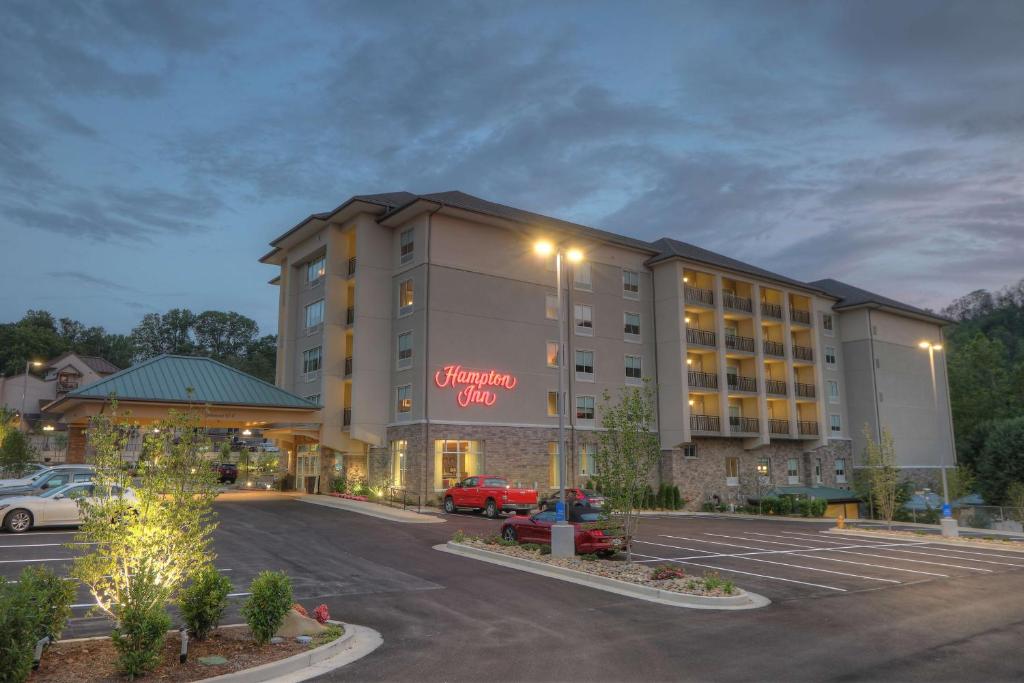
Hampton Inn Gatlinburg Historic Nature Trail
Nestled near the entrance of Great Smoky Mountains National Park and just minutes from the Gatlinburg Convention Center and Space Needle, the Hampton Inn Gatlinburg Historic Nature Trail offers a peaceful yet central stay. Guests can enjoy a complimentary self-serve breakfast each morning, unwind by the outdoor firepit, or relax in the landscaped garden. The hotel also features an indoor pool with sun loungers, a fitness center, and convenient amenities like dry cleaning, concierge service, and multilingual staff. Each of the 114 sound-insulated rooms includes free WiFi, flat-screen TVs with premium channels, and kitchen essentials like refrigerators, dishwashers, and microwaves. With high marks for cleanliness, spaciousness, and a walkable location, this modern retreat makes a great base for both exploring the Smokies and enjoying downtown Gatlinburg.
Buy Now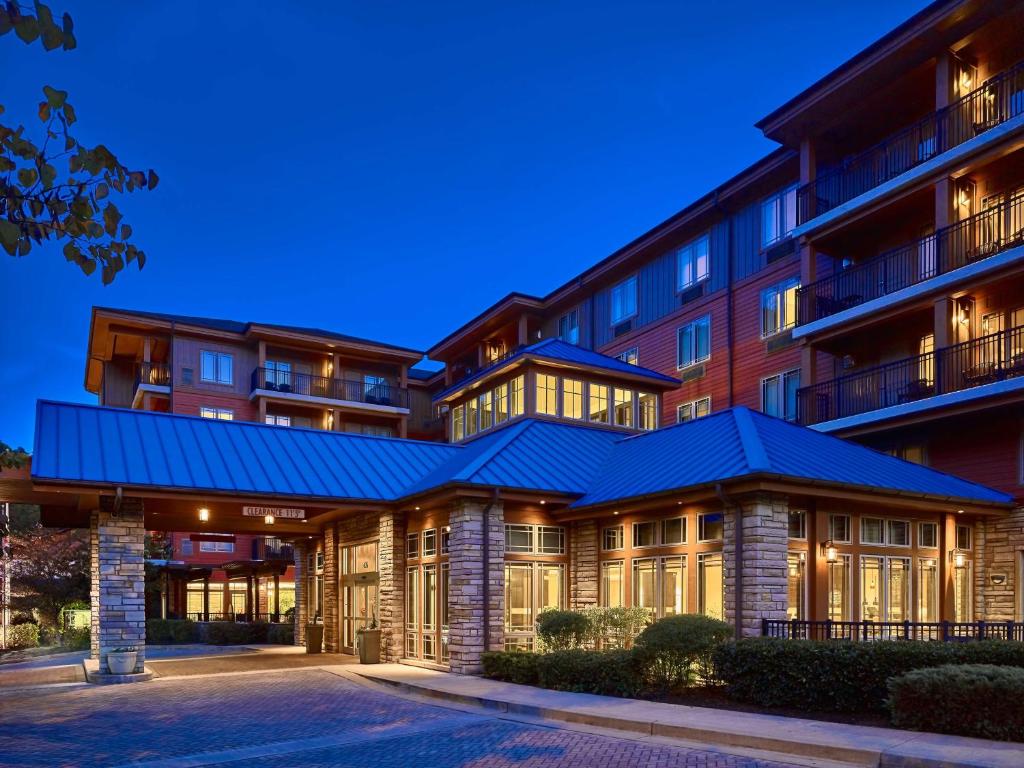
Hilton Garden Inn Gatlinburg
This pet-friendly, smoke-free hotel features free WiFi, an indoor pool and hot tub, on-site dining at the Garden Grille with a bar and happy hour, a fitness center, family-friendly amenities like in-room microwaves and refrigerators, free parking (including accessible options), cooked-to-order breakfast, a business center with over 1,100 sq ft of meeting space, laundry facilities, and convenient access to golf, tennis, hiking, and skiing, all in a five-story building built in 2009 with extensive accessibility features throughout.
Book Now
Historic Rocky Waters Inn
Newly remodeled in 2024, Historic Rocky Waters Inn, A Small Luxury Hotel offers upscale comfort just steps from Ripley’s Aquarium of the Smokies, Anakeesta, and SkyPark. This boutique retreat blends modern elegance with Gatlinburg charm, featuring a scenic terrace, outdoor entertainment space, and a cozy bar. Guests can enjoy breakfast or dinner at the on-site restaurant, The Heirloom Room, and stay connected with free in-room WiFi. Additional perks include free self-parking, concierge service, and express check-in/check-out for added convenience. Each guestroom is thoughtfully designed with premium bedding, air conditioning, and bathrobes, plus modern touches like 50-inch flat-screen TVs, workspaces, and balconies. With glowing reviews for its walkable location and attentive service, this small luxury stay is perfect for travelers seeking both style and substance in the Smokies.
Check Availability
Margaritaville Resort
Conveniently situated in the Gatlinburg part of Gatlinburg (TN), this property puts you close to attractions and interesting dining options. This 4-star property is packed with in-house facilities to improve the quality and joy of your stay.
Buy Now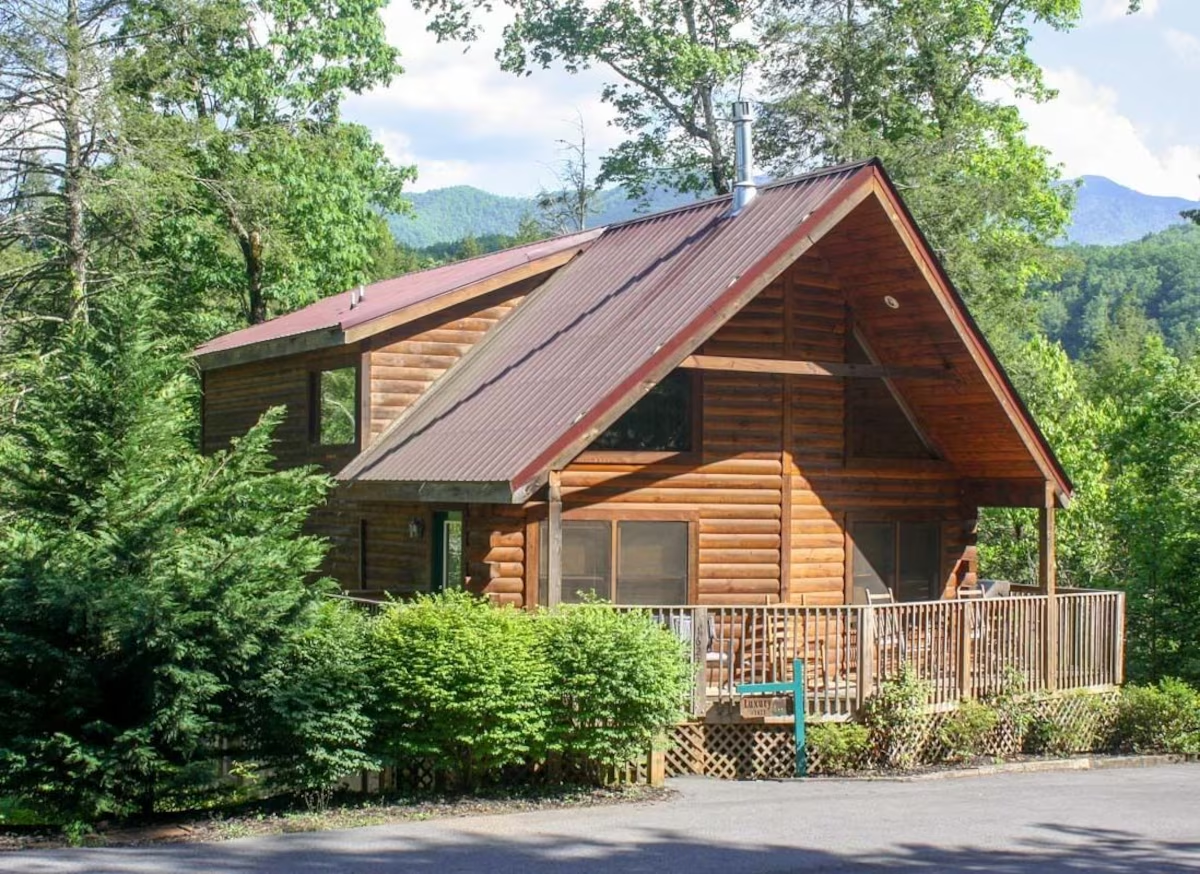
Mountain Shadow Resort & Rentals
Experience rustic luxury in the heart of the Smokies at Mountain Shadows Resort Rentals, where charming log cabins meet modern convenience. Whether you're planning a romantic honeymoon or a lively family reunion, this resort offers spacious accommodations complete with hot tubs, fireplaces, fully equipped kitchens, game rooms, and even gas/electric grills for cookouts under the stars. Guests can enjoy on-site amenities like a seasonal swimming pool, children’s playground, free high-speed WiFi, and pet-friendly options—making it easy for everyone to feel at home. Nestled adjacent to the Great Smoky Mountains National Park and conveniently located near the Gatlinburg trolley line, you're never far from scenic hikes, mountain views, and local attractions. While the resort holds an average rating of 3.1, many guests appreciate its peaceful setting and unique log-home atmosphere. With family rooms, non-smoking options, and features like whirlpool tubs and fireplaces, Mountain Shadows Resort invites you to unwind, explore, and make lasting memories in one of Gatlinburg’s most scenic spots.
Buy Now
River Edge Inn
Conveniently located near the Gatlinburg Convention Center, Gatlinburg Space Needle, and Ripley's Believe It or Not Museum, River Edge Inn offers a welcoming stay just steps from the action. Guests can start their day with a complimentary to-go breakfast, relax on the terrace, or unwind by the cozy lobby fireplace. The hotel features a seasonal outdoor pool and children’s pool with sun loungers, as well as a snack bar/deli, free self-parking, and high-speed in-room WiFi (50+ Mbps). Each guestroom is equipped with premium bedding, air conditioning, a private balcony, and essentials like a microwave, refrigerator, and 32-inch TV with premium channels. Families will appreciate extras like hypoallergenic bedding and available cribs, while guest reviews consistently praise the helpful staff and clean, comfortable rooms. Whether you're here for business or a mountain getaway, River Edge Inn delivers easy comfort in a prime downtown location.
Buy Now
River Terrace Resort and Convention Center
Just steps from Ripley’s Aquarium of the Smokies, Anakeesta, and SkyPark, River Terrace Resort & Convention Center offers comfort, convenience, and a touch of Southern hospitality in the heart of Gatlinburg. Guests enjoy a complimentary to-go breakfast each morning and can take advantage of an outdoor pool, free self-parking, and practical amenities like laundry facilities and a business center. The resort also offers concierge service, tour assistance, and express check-out to make your stay hassle-free. Each of the 205 rooms is equipped with air conditioning, flat-screen TVs, in-room safes, and free WiFi, along with bathrooms that feature hydromassage showers or tubs. With high marks for its friendly staff and central location, River Terrace is an ideal base for exploring the Smokies or attending events downtown.
Buy Now
Sidney James Mountain Lodge
Set against the scenic backdrop of the Smoky Mountains, Sidney James Mountain Lodge offers a warm, family-friendly retreat just minutes from Gatlinburg’s top attractions. Guests enjoy free WiFi, cozy rooms with flat-screen TVs, in-room coffee, air conditioning, and private balconies in select accommodations. Relax in style with access to three outdoor pools, a serene indoor pool, a kids' pool, and a soothing sauna—perfect after a day of exploring. On-site free parking adds convenience, while the Poolside Café, serving breakfast and lunch, makes grabbing a bite easy. Located near beloved local art galleries like Fowler’s Clay Works and the Great Smoky Arts & Crafts Community, Sidney James is more than just a place to stay—it’s a gateway to the charm and adventure of Gatlinburg. Pet-friendly and offering a variety of room types including suites, it’s a comfortable, value-rich option for families, couples, and explorers alike.
Book Now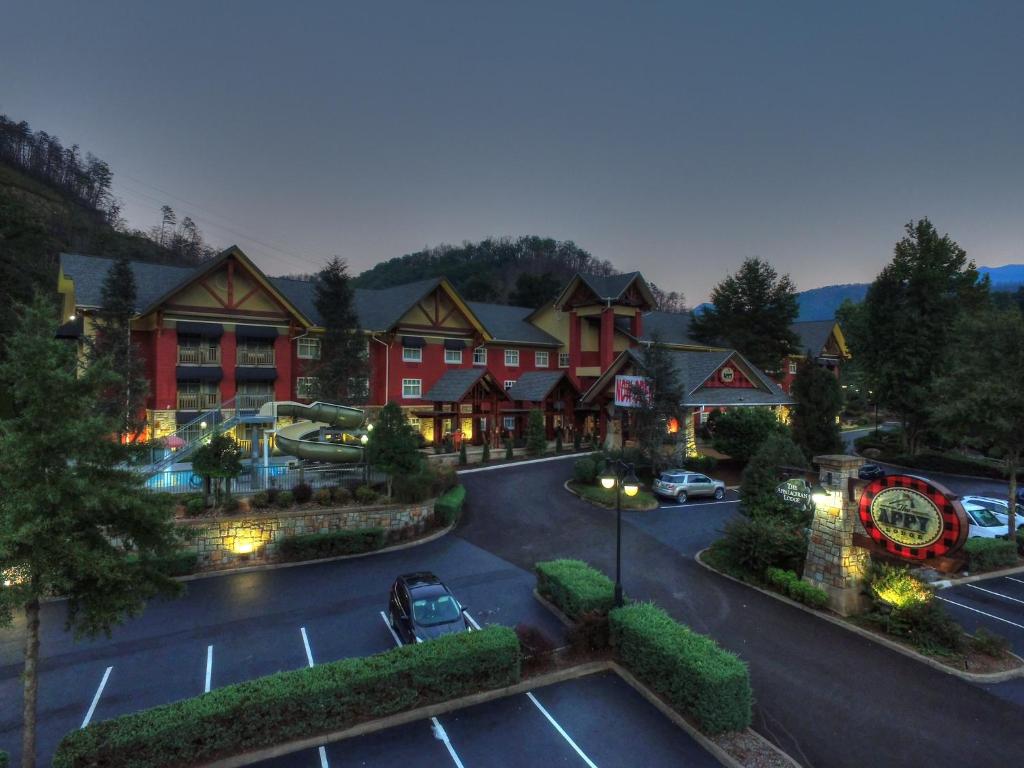
The Appy Lodge
Just a short distance from Anakeesta, Ripley’s Aquarium of the Smokies, and Ole Smoky Moonshine Distillery, The Appy Lodge offers a charming blend of comfort and convenience in the heart of Gatlinburg. Guests can unwind in the hot tub, enjoy a swim in either the seasonal outdoor pool or indoor pool, and stay active at the on-site gym. The hotel also features a terrace, business center, gift shop, and free self-parking. Each of the 101 rooms is designed with guest comfort in mind, offering premium bedding, air conditioning, free WiFi, and thoughtful amenities like flat-screen TVs, mini fridges, and microwaves. With laundry facilities, 24-hour front desk service, and tour assistance available, The Appy Lodge delivers a relaxed, welcoming stay just minutes from the area’s top attractions.
Buy Now
The Park Vista
Rising above downtown Gatlinburg on Cherokee Orchard Road, The Park Vista offers a quieter hillside stay with sweeping city and Smoky Mountain views. Families can enjoy the multi-level indoor pool complex with waterslides, a children’s area, and whirlpool, while several on-site dining options make breakfast, coffee, drinks, and relaxed evening meals convenient. Guest rooms include king, two-queen, and double-king configurations, with select rooms offering balconies and designated mountain or city views. Complimentary Wi-Fi, Hilton Honors benefits, connecting-room options, and a free Gatlinburg trolley stop at the hotel add practical value. Breakfast and self-parking cost extra, so compare the complete rate before booking. With its distinctive circular tower, full-service amenities, and separation from the Parkway crowds, The Park Vista is especially well suited to families, couples, and national park visitors who value scenery over immediate downtown walkability.
Check Availability Now
Greystone Lodge on the River
Set beside the river in the heart of downtown Gatlinburg, Greystone Lodge on the River offers an exceptionally convenient base beside Ripley’s Aquarium of the Smokies and just across the Parkway from Anakeesta. Guests receive complimentary breakfast, free self-parking, free Wi-Fi, and access to a seasonal heated outdoor pool with a waterslide. Every room includes a balcony or ground-floor patio, while selected riverfront rooms and suites add water views, fireplaces, soaking tubs, or family-friendly sleeping arrangements. A trolley stop at the hotel entrance provides another easy way to explore town. Greystone does not offer an indoor pool, spa, or on-site restaurant, and not every room overlooks the river, so check the exact room category before booking. With its walkable location, included essentials, and relaxed riverfront setting, Greystone is especially well suited to families, couples, and first-time visitors who want to leave the car parked and spend their holiday exploring Gatlinburg.
Check Availability Now
Embassy Suites by Hilton Gatlinburg Resort
Set less than half a mile from downtown Gatlinburg, Embassy Suites by Hilton Gatlinburg Resort offers a modern, family-focused stay near the Great Smoky Mountains National Park. Guests receive complimentary made-to-order breakfast, free Wi-Fi, and access to the nightly Evening Reception. Spacious accommodations, an indoor pool, and a seasonal outdoor pool complex with a lazy river and waterslide make the resort particularly appealing to families planning a multi-night stay. An on-site restaurant, bar, fitness centre, and pet-friendly rooms add further convenience. Embassy Suites is not directly on the Parkway, however, and the uphill return from downtown may prove tiring for young children or travellers with limited mobility. On-site self-parking also carries a nightly charge, while the lazy river and waterslide are seasonal. With its additional living space, included breakfast, and unusually strong pool facilities, Embassy Suites is best suited to families and larger groups who will use the amenities enough to justify the higher total price.
Check Availability Now
Old Creek Lodge
Set along a mountain stream on River Road, Old Creek Lodge offers a comfortable base between downtown Gatlinburg and the entrance to Great Smoky Mountains National Park. Every room includes a private stream-facing balcony, gas fireplace, mini-refrigerator, microwave, and Keurig coffee maker, giving the property more character and practicality than a typical downtown hotel. Guests also receive complimentary continental breakfast, free Wi-Fi, free on-site parking, and access to a heated seasonal outdoor pool. The western Parkway, Ober Mountain Aerial Tramway, and several restaurants and attractions are within walking distance, although destinations near Ripley’s Aquarium and Anakeesta require a longer stroll. Old Creek Lodge does not offer an indoor pool, restaurant, bar, spa, or extensive resort facilities, and pets are not permitted. Whirlpool tubs are available only in selected Spa room categories. With its creekside balconies, fireplaces, convenient location, and consistently strong guest feedback for cleanliness and service, Old Creek Lodge is particularly well suited to couples, small families, and park-focused travelers who prefer room atmosphere and walkability over resort-style extras.
Check Availability Now
The Historic Gatlinburg Inn
Set directly on the Parkway in the heart of downtown, The Historic Gatlinburg Inn offers a characterful base beside Gatlinburg SkyPark and across from the Gatlinburg Space Needle. Guests receive a complimentary Southern hot breakfast, free Wi-Fi, free on-site parking, and access to a seasonal outdoor pool, along with inviting common areas featuring fireplaces, historic photographs, puzzles, and porch rocking chairs. Room layouts vary considerably, with options ranging from traditional standard rooms to corner rooms with wraparound balconies, family suites, parlor arrangements, Presidential Suites, and Room 388, where “Rocky Top” was written. Standard rooms do not automatically include a mini-refrigerator, microwave, or balcony, so guests should confirm the exact category before booking. The inn does not offer an indoor pool, hot tub, spa, fitness centre, full-service restaurant, or bar, and pets are not permitted. With its exceptional walkability, included parking and breakfast, authentic Gatlinburg history, and frequently praised hospitality, The Historic Gatlinburg Inn is particularly well suited to couples, families, music enthusiasts, and repeat visitors who value independent character over modern resort-style amenities.
Check Availability Now


A Perfect One-Day Free Gatlinburg Itinerary
One of the questions I hear most often from visitors is surprisingly simple:
“Can you really spend an entire day in Gatlinburg without spending much money?”
The answer is yes.
In fact, some of the most memorable days I’ve spent in the Smokies involved little more than a comfortable pair of walking shoes, a full tank of gas, and enough time to slow down and appreciate what makes these mountains special.
If you’re looking to experience the best free attractions in Gatlinburg without feeling rushed, this is the itinerary I would recommend.
If you’re trying to pull all of these free activities into a single trip plan, our completet
Morning: Start Where the Smokies Wake Up
The best time to experience the mountains is often before most visitors have finished breakfast.
The air is cooler, wildlife is more active, and the crowds are still asleep.
Begin at Sugarlands Visitor Center
Start your day at the Sugarlands Visitor Center just south of downtown Gatlinburg.
Take a few minutes to explore the exhibits, pick up maps, and learn more about the wildlife, history, and culture of the Great Smoky Mountains. Families traveling with children can also participate in the Junior Ranger program.
Walk the Gatlinburg Trail
From the Sugarlands area, enjoy a relaxed walk along the Gatlinburg Trail.
The trail follows the West Prong of the Little Pigeon River and provides a gentle introduction to the national park. Listen to the rushing water, watch for wildlife, and enjoy one of the few trails in the park that welcomes both bicycles and leashed dogs.
Visit Cataract Falls
Before leaving the area, make the short walk to Cataract Falls.
The waterfall is one of the easiest to access in the Smokies, making it a perfect stop for families, casual hikers, and anyone looking for a peaceful mountain setting without a strenuous climb.
Personal Take
This combination of Sugarlands, the Gatlinburg Trail, and Cataract Falls captures everything that makes the Smokies special—rivers, forests, wildlife, waterfalls, and history—all before lunchtime.
Afternoon: History, Forests, and Mountain Roads
As the day progresses, it’s time to venture deeper into the mountains.
Drive the Roaring Fork Motor Nature Trail
From Sugarlands, make your way to the Roaring Fork Motor Nature Trail.
This scenic one-way loop remains one of the finest drives in the Smokies. The road follows a rushing mountain stream through dense forest while passing many of the historic structures that tell the story of Appalachian life before the national park existed.
Drive slowly.
The scenery deserves it.
Explore the Historic Homesteads
Take time to stop at the Noah “Bud” Ogle Place, Ephraim Bales Cabin, Alfred Reagan Tub Mill, and other preserved sites along the route.
These aren’t simply old buildings.
They’re reminders that generations of mountain families built lives here long before tourism arrived.
Begin the Climb Up Newfound Gap Road
Rather than doubling back across the region, continue your afternoon by heading toward Newfound Gap Road.
As you climb higher into the mountains, the landscape begins to change. Temperatures cool, forests become denser, and the views become increasingly dramatic.
Stop at overlooks such as Campbell Overlook whenever something catches your eye.
Personal Take
One of the great pleasures of the Smokies is realizing that the journey itself often becomes the attraction.
Some of my favorite mountain memories came from unplanned stops at overlooks I hadn’t intended to visit.
Evening: End the Day Above the Clouds
As afternoon transitions into evening, the Smokies provide one final reward.
Watch Sunset at Morton Overlook
About one mile before reaching Newfound Gap, Morton Overlook offers one of the finest sunset views in the national park.
Arrive early enough to secure a parking spot and allow yourself time to watch the changing colors sweep across the ridges.
The mountains gradually fade into layers of blue, purple, gold, and gray as daylight disappears.
Return to Downtown Gatlinburg
After sunset, head back into town.
By now, the Parkway has taken on a completely different personality. Lights glow from storefronts, music drifts from open-air courtyards, and visitors fill the sidewalks enjoying the evening atmosphere.
Explore The Village Shops
Spend some time wandering through The Village Shops.
The fountains, brick pathways, and European-inspired architecture create one of the most pleasant evening walks in downtown Gatlinburg.
Finish With a Parkway Stroll
End your day with a leisurely walk along the Parkway.
There’s no agenda here.
Simply enjoy the atmosphere, watch the crowds, listen to the music, and soak in the unique energy that makes Gatlinburg one of America’s most beloved mountain towns.
Personal Take
I like this itinerary because it tells the complete story of the Smokies.
You begin beside a river.
You walk through the forest.
You explore mountain history.
You climb into the high elevations.
And you finish watching the lights come on in town below the mountains.
That’s a pretty remarkable day for something that costs almost nothing.
Final Thought
Aside from transportation costs and any required national park parking tag, this itinerary delivers a full day of waterfalls, scenic drives, mountain views, history, wildlife, and downtown exploration without requiring expensive attraction tickets.
And if you’re anything like many travelers I’ve met over the years, these simple experiences may end up becoming your favorite memories of Gatlinburg.
If you’re building a complete Smoky Mountain itinerary, including attractions, restaurants, scenic drives, seasonal activities, and local planning tips, our full Gatlinburg travel guide can help you connect everything together.

Gatlinburg Travel Guide 2025: Explore the Best Attractions, Outdoor Adventures, and Hidden Gems in the Heart of the Smoky Mountains
This Gatlinburg Travel Guide 2025 isn’t just a book—it’s a doorway to a life-changing adventure. Whether you’re drawn by the mountains, the history, or the people, Gatlinburg promises an experience that will stay with you long after you’ve left. Get ready to create unforgettable memories, and let this guide be your trusted companion along the way.
Buy Now
Frequently Asked Questions About Free Things to Do in Gatlinburg
Is anything actually free in Gatlinburg?
Yes. While many visitors associate Gatlinburg with attractions, ticketed experiences, and entertainment venues, some of the area’s most memorable experiences are completely free. Visitors can walk the Gatlinburg Trail, visit Cataract Falls, explore The Village Shops, ride the free Gatlinburg Trolley, enjoy scenic mountain drives, view wildlife, and visit historic sites throughout the Great Smoky Mountains without paying admission fees. In many cases, the natural beauty of the Smokies provides the most rewarding experiences of all.
Do I need a parking tag for free attractions in Gatlinburg?
It depends on where you park.
If your vehicle is parked inside Great Smoky Mountains National Park for longer than 15 minutes, you must display a valid parking tag. This includes popular free locations such as the Gatlinburg Trail, Cataract Falls, Sugarlands Visitor Center, Roaring Fork Motor Nature Trail, and many scenic overlooks.
Downtown Gatlinburg attractions, including The Village Shops, Arrowmont Galleries, and most city locations, do not require a national park parking tag.
How much does the Great Smoky Mountains parking tag cost?
The current Great Smoky Mountains National Park parking tag options are:
- Daily Tag: $5
- Weekly Tag: $15
- Annual Tag: $40
Parking tags can be purchased online through Recreation.gov or at designated visitor centers and automated kiosks, including those located near Sugarlands Visitor Center.
It’s important to remember that the parking tag is separate from park admission. Entrance to Great Smoky Mountains National Park remains free.
Can I bring my dog on any of the free trails in Gatlinburg?
Yes, but options are limited.
The Gatlinburg Trail is one of only two trails within Great Smoky Mountains National Park that allows leashed dogs. Because pets are prohibited on most park trails, the Gatlinburg Trail has become a favorite option for visitors traveling with their four-legged companions.
The trail is also relatively flat, making it suitable for casual walks with pets.
Where can I watch candy-making demonstrations for free?
One of the most enjoyable free downtown experiences is watching candy being made at Ole Smoky Candy Kitchen.
Visitors can stand outside the viewing windows and watch employees stretch, pull, cut, and package taffy using traditional methods that have been part of Gatlinburg culture for decades. The demonstrations are free, family-friendly, and one of the most authentic small-town experiences along the Parkway.
Is the Gatlinburg Trolley really free?
Yes.
The Gatlinburg Trolley system is completely free to ride and remains one of the best budget-friendly resources in town. Visitors can use the trolley to travel throughout much of Gatlinburg without worrying about parking, traffic, or transportation costs.
For travelers looking to minimize expenses, the trolley can save both time and money during a vacation.
Can visitors explore the historic cabins for free?
Yes.
Many of the historic homesteads preserved throughout the national park can be viewed free of charge. Locations such as the Noah “Bud” Ogle Place, Ephraim Bales Cabin, John Ownby Cabin area, and Alfred Reagan Tub Mill provide fascinating glimpses into Appalachian life before the creation of the national park.
Accessibility to individual structures may vary depending on preservation efforts and seasonal conditions, but visitors can freely explore the surrounding historic sites.
What is the best time of day to see wildlife in the Smokies?
Early morning and late evening generally offer the best wildlife viewing opportunities.
These quieter hours often provide the greatest chances of spotting white-tailed deer, wild turkeys, and occasionally black bears. Areas such as Sugarlands, Roaring Fork, Cades Cove, and Oconaluftee are particularly well known for wildlife sightings.
Patience is essential. Wildlife viewing is never guaranteed, but slowing down and spending time in the right locations often produces rewarding encounters.
What is the best free attraction in Gatlinburg?
If I could recommend only one free attraction, it would be the Gatlinburg Trail.
It combines mountain scenery, river views, wildlife opportunities, historic remnants, and easy accessibility into a single experience. It also serves as a natural bridge between downtown Gatlinburg and Great Smoky Mountains National Park, making it one of the most versatile attractions in the area.
Can I spend an entire day in Gatlinburg without spending money?
Absolutely.
A visitor could spend the morning exploring Sugarlands Visitor Center, the Gatlinburg Trail, and Cataract Falls. The afternoon could be devoted to Roaring Fork, historic cabins, scenic overlooks, and wildlife viewing. The evening could include sunset at Morton Overlook, a stroll through The Village Shops, and a walk along the Parkway.
Aside from transportation costs and any required national park parking tag, an entire day of memorable experiences can be enjoyed without spending money.
Are free activities available year-round in Gatlinburg?
Yes.
Every season offers unique free experiences. Spring brings wildflowers and rushing waterfalls. Summer offers rivers, wildlife viewing, and scenic drives. Fall delivers spectacular foliage and mountain vistas. Winter provides long-range mountain views, festive atmosphere, and fewer crowds.
No matter when you visit, Gatlinburg offers countless opportunities to experience the Smokies without paying admission fees.
Final Thoughts on the Best Free Things to Do in Gatlinburg
The Best Smoky Mountain Memories Cost Nothing
After years of exploring mountain towns across North America and countless visits to the Great Smoky Mountains, I’ve noticed an interesting pattern in the stories travelers tell when they return home.
Rarely do their favorite memories begin with the attraction that cost the most money.
Instead, people talk about the black bear they unexpectedly spotted along a quiet mountain road early one morning. They remember standing beside the rushing waters of the West Prong of the Little Pigeon River with a cup of coffee in hand. They remember exploring a weathered log cabin tucked into the forest and imagining what life was like for the families who called these mountains home generations ago. They remember watching sunlight fade across the ridges from a scenic overlook as the mountains slowly turned shades of blue, violet, and gold.
Those moments become the stories that last.
The Great Smoky Mountains have a remarkable way of reminding us that the most valuable parts of a vacation rarely come with an admission fee.
Gatlinburg certainly offers plenty of attractions, mountain coasters, dinner theaters, observation decks, and entertainment venues that deserve their popularity. There is absolutely nothing wrong with building some of those experiences into your trip.
But the mountains surrounding the town offer something equally valuable.
They offer an invitation to slow down.
To spend a little more time beside a river.
To take the scenic road instead of the fastest one.
To linger at an overlook long after you’ve taken the photograph.
To sit quietly and appreciate a landscape that has inspired visitors for generations.
Some of my favorite Smoky Mountain memories have come from simple moments: walking the Gatlinburg Trail on a cool spring morning, listening to Roaring Fork Creek rush through the forest, watching fog drift through the valleys after a summer rainstorm, or standing at Morton Overlook as the final light disappeared behind the mountains.
None of those experiences required a ticket.
All of them remain unforgettable.
As you plan your visit, use this guide as a foundation rather than a checklist. The most rewarding Gatlinburg vacations usually combine a mix of free experiences, local restaurants, scenic drives, and a few carefully chosen attractions. Finding that balance often creates the best trips.
Ready to Build Your Complete Gatlinburg Itinerary?
To continue planning your Smoky Mountain adventure, explore these local resources:
- Things To Do In Gatlinburg — Discover even more attractions, activities, and experiences throughout the area.
- Where To Stay In Gatlinburg — Find the right cabin, resort, hotel, or mountain retreat for your travel style and budget.
- Gatlinburg Restaurants — Explore local favorites, family restaurants, breakfast spots, steakhouses, barbecue joints, and hidden gems worth adding to your itinerary.
At the end of the day, the best part of a Smoky Mountain vacation is often the simplest.
It’s finding a quiet place to stand, looking out across the endless ridges, listening to the sounds of the mountains around you, and appreciating exactly where you are.
In Gatlinburg, many of those unforgettable moments are still completely free.
